Cultural Change in Organisations: The Ultimate Guide

The world around us is changing at a breathtaking pace. Markets are shifting, new technologies are revolutionising entire industries, and the expectations of both staff and customers are constantly evolving. Amidst this dynamic environment, it is no longer enough for you, as a manager, HR manager or decision-maker, to simply optimise processes or introduce new software. The real key to long-term business success lies much deeper: in cultural change.

Successful cultural change within organisations is far more than just a modern buzzword. It is the foundation upon which future-proof, resilient and innovative organisations are built. If you wish to bring about a lasting, positive change in the way your organisation thinks, acts and communicates, you face a complex but immensely rewarding task.

This ultimate guide will take you through every stage of this transformation process. We’ll show you what constitutes genuine cultural change, what hurdles you can expect to face, how to overcome them successfully, and why visual communication is key to taking everyone on board on this journey.

1. What is cultural change?

Before you embark on a transformation, it is crucial that you and your leadership team develop a shared understanding of exactly what is to be transformed. Decision-makers often ask themselves: When will our cultural change actually be complete? The honest answer is: never. It is an ongoing, dynamic process that redefines the unwritten rules of your organisation.

Definition of cultural change

Cultural change describes the deliberate and systematic process of changing values, norms, attitudes and behaviours within an organisation. It involves a genuine shift in values. Whilst structural changes often take place on paper (such as a new organisational chart), cultural change takes place in the minds and hearts of your staff. At its core, it answers the question: ‘How do we do things here when nobody is looking?’

For you, successful cultural change means breaking down old, obstructive patterns of thinking and replacing them with new, supportive principles.

The role of organisational culture

Your organisational culture is your company’s operating system. As the management thought leader Peter Drucker so aptly put it: “Culture eats strategy for breakfast”. You can develop the most brilliant business strategy in the world – but if your organisational culture isn’t aligned with it, the strategy will fail.

Culture has a significant influence on your day-to-day work:

  • Decision-making: Are risks penalised or seen as an opportunity to learn? 
  • Collaboration: Is there a silo mentality or cross-departmental cooperation? 
  • Innovation: Do your staff feel confident enough to voice unconventional ideas?

If you want to make your company more agile, customer-focused or digitally oriented, you absolutely must start with the organisational culture. It is the breeding ground for any sustainable change.

The difference between cultural change and change management

These two terms are often used interchangeably, but that is an oversimplification. As a decision-maker, it is important for you to understand the subtle differences:

  • Change management: This is the methodology. It encompasses the tools, processes and plans required to transition a specific change (e.g. a new IT infrastructure) from state A to state B. It is structure-driven. 
  • Cultural change: This is the mindset. It is about emotions, identity and long-term behavioural changes amongst the people in your organisation.

What this means in practice: Professional change management provides you with the practical tools to make cultural change manageable in the first place. Without sound change management, cultural change will fizzle out despite good intentions.

2. Challenges in cultural change

Initiating a cultural shift requires courage on your part. As soon as you challenge the status quo, you will inevitably encounter obstacles. Those who recognise these challenges early on can take proactive action.

Resistance from employees

Arguably the biggest hurdle in any transformation process is human resistance. Change means uncertainty, and uncertainty often triggers stress or resistance.

Typical comments you’ll come across include:

  • “That’s how we’ve always done things here.”
  • “It’s just another consultant’s idea.”
  • “I don’t have time for that with my busy workload.”

This resistance is rarely malicious. It stems from a fear of losing one’s expertise or a lack of information. For you, this means that resistance must not be ignored or penalised. It is important feedback. Take your workforce’s concerns seriously and create opportunities for dialogue.

Lack of leadership skills

A cultural shift within a company almost always fails if management does not stand united behind it. If you demand agility and an open culture of learning from mistakes from your teams, yet practise micromanagement and punish mistakes in day-to-day operations, a toxic disconnect arises between words and actions.

Managers must act as absolute role models (lead by example). A common problem is that whilst managers may be excellent in their technical roles, they often lack the communication skills needed to guide people through uncertain emotional phases.

Unclear corporate values

Many companies adorn their intranets with buzzwords such as ‘respect’, ‘innovation’ or ‘customer focus’. But what do these buzzwords actually mean in the hectic day-to-day reality of project work?

If values remain abstract and are not translated into concrete behavioural guidelines, they are ineffective. Unclear visions lead to every employee interpreting the cultural change differently. They lack a common thread that provides guidance to everyone involved.

3. Strategies for successful cultural change

How can you overcome these hurdles and successfully nurture the seeds of a new corporate culture? The following strategies have proved to be extremely effective in practice.

Employee involvement (employee engagement)

Culture cannot be imposed by a management decision or enforced. It must be developed and lived out collectively. The most important strategy for you is therefore: turn those affected into active participants.

You can achieve a high level of employee engagement through:

  • Participatory formats: Use workshops to work out together what the new values should look like in everyday life.
  • Culture ambassadors (change agents): Identify highly motivated staff who can authentically drive change within their respective departments.
  • Feedback loops: Establish pulse surveys to regularly assess where the organisation stands.

Creating a positive working environment

Cultural change requires a safe environment. Only when your staff feel psychologically safe will they break old habits and dare to try new things.

  • Establish a culture of learning from mistakes: Don’t just celebrate successes. Talk openly about failures and the lessons learnt from them. As a manager, lead by example.
  • Create space: A positive shift in values takes time. Give your teams the space they need to come to terms with new requirements.
  • Show recognition: Appreciation is a huge motivator. Visible praise for behaviour that aligns with the new culture reinforces it in the long term.


Communication as the key

Communication is the very heart of any transformation. Yet traditional text-based newsletters or endless PowerPoint presentations often fail to make an impact. They may inform, but they do not inspire.

This is where DIALOGBILD’s visual approach comes into play. Instead of burying complex strategies in walls of text, you should make the goal tangible:

  • Make use of visual maps: A richly illustrated image, developed specifically for your organisation, shows the path from the current reality to the new target culture. It breaks down complexity.
  • Encourage direct dialogue: A visual overview invites staff to talk to one another. You can literally point to scenarios and say: “This is exactly where we stand today. And this is how we want to work together in the future.”
  • Ensure clarity: Visual communication tools prevent misunderstandings, as images speak a universal language that is instantly understood

4. Best practices and case studies

Theory is important, but what does successful cultural change look like in practice? Let’s take a look at two illustrative case studies from which you can draw valuable insights for your own strategy.

Case study 1: From a long-established company to an agile organisation

The situation: A medium-sized manufacturer with 1,500 employees was losing market share because decision-making processes, which spanned five hierarchical levels, were too slow. Silo mentality characterised day-to-day operations.

The solution: Management initiated a comprehensive cultural transformation within the company. Instead of dry instructions, the focus was placed on visual dialogues. With the help of a bespoke ‘DIALOG PICTURE, all shop-floor staff were shown why the company needed to change. Managers were trained as dialogue facilitators.

The result: The visual support helped staff overcome their fears. Departments began to cooperate across functional boundaries. The development time for new products was noticeably reduced.

Case Study 2: Structure for a scaling start-up

Background: A rapidly growing tech company (which had grown from 50 to 300 employees in two years) realised that its original start-up culture was being lost. Responsibilities had become unclear.

The solution: The company needed to undergo a shift in values – moving away from chaos towards reliable processes. In interactive workshops, the company’s values were redefined and presented in a clear, visual map.

The result: The staff turnover rate fell significantly. New employees were able to integrate into the company culture much more quickly thanks to the visually supported onboarding process.

Practical lessons learnt at a glance

Key to success Traditional approach (avoidance) Successful cultural change (Focus)
Communication Top-down emails, walls of text Visual maps & real conversations
Integration Simply informing the workforce Active participation & workshop formats
Attitude towards mistakes Cover-ups & Sanctions Open learning culture & transparency
Leadership Instructing & Monitoring Leading by example, empowering & coaching

5. The Future of Cultural Change

The world of work never stands still. If you want to future-proof your business, you need to be aware of the trends that will shape tomorrow’s cultural change.

The Impact of Technology

The rapid development of artificial intelligence (AI) and digital tools is having a massive impact on your corporate culture. As machines increasingly take on standardised tasks, people – with their soft skills such as creativity, empathy and critical thinking – are taking centre stage.

At the same time, hybrid working requires new ways of fostering a sense of togetherness. Chats by the coffee machine are often no longer possible. You need to deliberately create (digital) spaces for informal dialogue so that all employees feel equally involved.

Changing employee expectations

The expectations of younger generations are transforming the labour market. An attractive salary alone is no longer enough. Your employees are seeking a sense of purpose, demanding flexible working arrangements and expecting a genuine commitment to sustainability. A sustainable cultural transformation must absolutely address these expectations.

The role of leaders in the future

We are finally saying goodbye to the image of the authoritarian, all-knowing manager. Your role as a leader is evolving into that of an enabler and a source of purpose. Your most important task will be to make connections clear, build bridges and, through honest, often visually supported communication, create an environment in which your team can take ownership and excel.

Conclusion: Your path to a vibrant corporate culture

Cultural change within organisations is one of the most challenging, yet also one of the most rewarding, tasks of modern business leadership. It requires perseverance, a clear vision, targeted change management and, above all, an honest dialogue with your staff that breaks down barriers.

If you recognise resistance as a natural part of the process, actively involve your teams and visualise complex changes – for example, through a bespoke DIALOGBILD – in a way that everyone can understand, you will lay the foundations for sustainable success. A strong, lived organisational culture is your greatest competitive advantage, one that cannot be copied.

Let’s work together to bring your cultural transformation to life!

Is your organisation facing a cultural transformation? Would you like to make your vision tangible, experiential and understandable for all staff?

At DIALOGBILD, we support you in translating complex change processes into clear, bespoke visual formats. We help you spark genuine conversations and take your workforce on this journey in a way that lasts. No more walls of text – it’s time for clarity and dialogue.

Don’t hesitate – get in touch with us to discuss your specific challenges. Arrange a no-obligation initial consultation with our experts today. Together, we’ll discover how visual communication can make your cultural transformation a success.

Get in touch now and arrange a no-obligation consultation with DIALOGBILD!

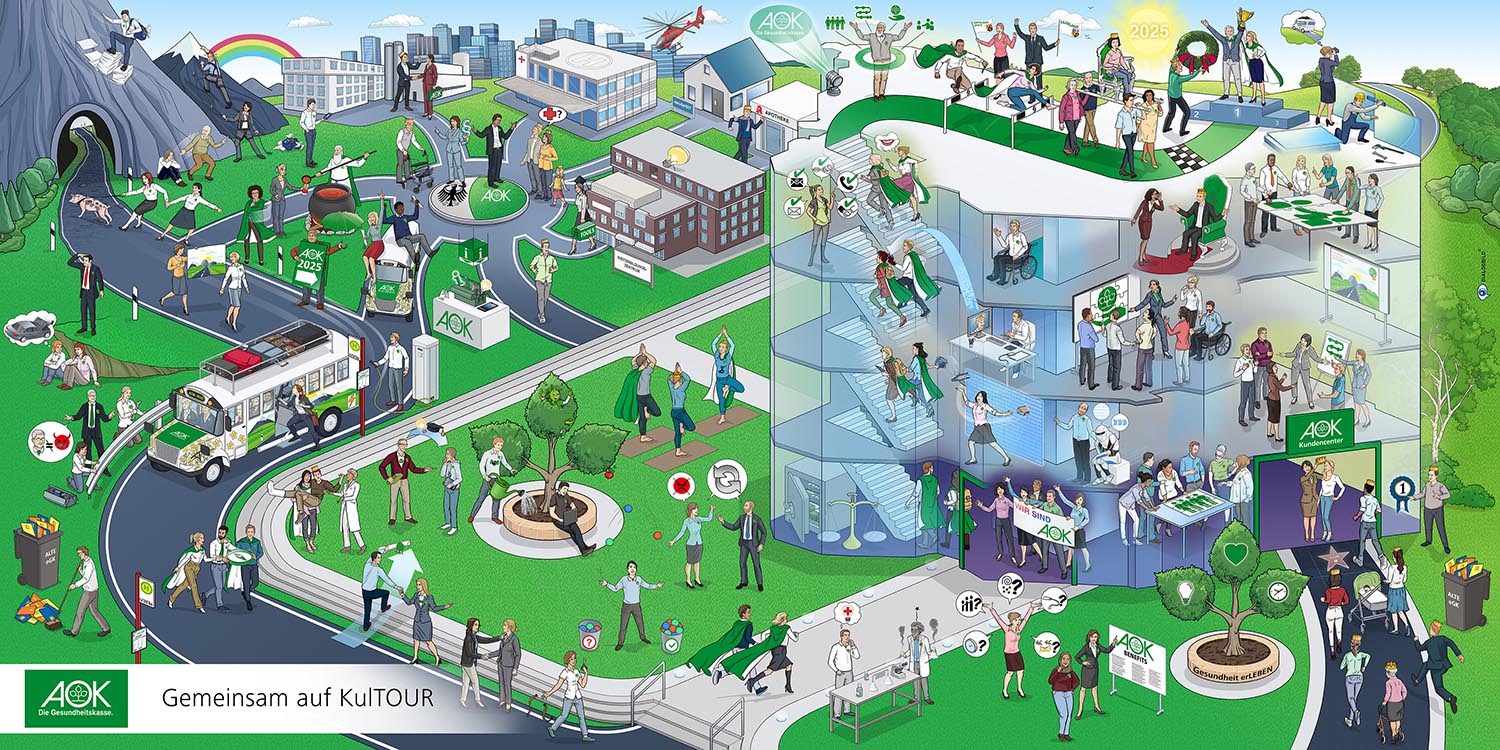
AOK Gemeinsam auf KulTOUR Leitbild Visionsbild Dialogbild Agentur für Visualisierung von Prozessen, Veränderungen und Visionen.

OUR CULTOUR CHANGE


AOK Rheinland-Pfalz/Saarland - The health insurance company is the largest health insurance company in the two federal states of Rhineland-Palatinate and Saarland, with over 1. 2 million insured persons and 85,000 supervised employers as well as around 3,500 employees. The health insurance fund maintains business relationships with more than 100 hospitals, 10,000 doctors, psychotherapists and dentists, around 1,300 pharmacies and many hundreds of other contract partners. It offers high-quality care for the population and tailor-made concepts in the regions. For this, modern, future-oriented structures are also essential in the corporate culture.

In the framework of the"Together on CulTOUR" programme, develops a vision of the future and principles for leadership and cooperation. The existing brand mission statement of the AOK-community was adapted.

The aim of the dialog picture is to communicate the developed products, to permanently anchor them and thus to create a successive "KulTOURwandel" which will prepare the AOK Rheinland-Pfalz/Saarland for the future challenges of the health and nursing insurance market.

With the help of the dialog picture, the complex contents have been depicted and brought into an overall context. This ensures a common understanding of the new. A further advantage is that all employees deal with the topics not only on the rational, but also on the emotional level, and the dialog picture provides space for constructive discussions and a valuable exchange of experiences or opinions.

VW Nutzfahrzeuge Volkswagen Nutzfahrzeuge Transformation Werk Hannover Leitbild Strategiebild Dialogbild Agentur für Visualisierung von Prozessen, Veränderungen und Visionen.

TRANSFORMATION PLANT HANOVER


Process optimization, strategy, cultural work and good communication are key to the VW Nutzfahrzeuge plant management Hanover in leading the way to a successful future. In the past, strategy and transformation processes were often accompanied by powerpoint "battles".There were numerous charts that tried to make it as comprehensible as possible what goals the company wanted to achieve and how it planed to get there.

Now the company wants to go other ways and has developed a vision for the future together with Goldpark and DIALOGBILD. On the one hand, the picture emerged in an intensive process, on the other hand, the discussion about the things that are important to the board in the picture led to a common understanding and also made it possible for different perspectives to be discussed and brought together.

This helps the Hannover plant to communicate its way into the the future with a common voice.

Thanks to the close cooperation between Goldpark and DIALOGBILD, the dialog picture was used for all events, informations and formats that relate to the transformation as well as to reflect the developments in the transformation process.

Alstom Transformationprogramm gera 2020 Leitbild Strategiebild Infografik Dialogbild Agentur für Visualisierung von Prozessen, Veränderungen und Visionen.

Logo von Alstom

TRANSFORMATION MAP „GERA 2020“


ALSTOM Transport Deutschland GmbH is faced with major challenges, the change strategy has to not only be communicated, but above all be lived. Jens Bünte (Personnel Manager for Germany & Austria) turned to DIALOGBILD with this goal. The situation of the company became clear relatively quickly and so we developed a communication strategy, which is not only visually appealing, but also captivating. Since the success of a strategy depends decisively on the acceptance and participation of the employees, we agreed on two creative workshops in order to elaborate the concept. The first workshop took place with around 15 executives and resulted in a landscape where a hub was chosen as the central point of the dialog picture.

It was important to highlight the past of the company, to specify the path of the "GerA 2020" transformation program and to use a part of the picture to show the future. These preliminary considerations were unanimously accepted by the second workshop group and further elaborated. With 20 change agents from different fields, the picture was then discussed and implemented together with all participants and scenes were placed in the landscape. At the end of the second workshop, the dialog picture was absolutely complete and the story was largely written. Decisions were made for positive and negative presentations, which should appeal to all employees and encourage them to think. With only one goal: to lead the transformation program to success together.

Frequently Asked Questions (FAQ) on organisational culture change

How long does it take to bring about cultural change within a company?

Genuine cultural change is not a short-term project with a fixed end date, but rather an ongoing process of development. The first noticeable changes and successes usually become apparent after 6 to 12 months of intensive work. It generally takes 2 to 5 years for new values, behaviours and ways of thinking to become deeply embedded in the organisation’s DNA – depending on the size of the company, the complexity of its structures and the consistency of its leadership.

How can the success of a cultural transformation be measured?

Although culture is a ‘soft’ factor, its transformation can be measured using specific quantitative and qualitative indicators:

  • Qualitative data: Regular pulse surveys on employee satisfaction, measurement of the trust index and feedback from performance reviews.
  • Quantitative metrics: Trends in staff turnover, sickness absence, the Employee Net Promoter Score (eNPS) and the number of CIP (Continuous Improvement Process) suggestions submitted.
  • Operational results: Shorter decision-making processes, faster project completion times and a higher rate of innovation.

What is the main difference between cultural change and change management?

Change management provides the methodological tools: it plans, structures and steers specific changes (such as IT roll-outs or restructuring) from state A to state B. Cultural change, on the other hand, concerns people’s inner attitudes, values and everyday behaviours. In short: change management organises the change – cultural change brings it to life, fostering trust and acceptance.

How does DIALOGBILD support cultural change in practice?

DIALOGBILD translates your abstract strategies, corporate values and target cultures into bespoke visual target images and dialogue media. This creates a comprehensive visual overview that makes complex interrelationships understandable and breaks down barriers between departments and across hierarchical levels. In facilitated workshops, DIALOGBILD’s visual materials act as a catalyst to actively engage employees in dialogue, allay fears and develop a shared vision of the future.

What can you do if leaders fail to lead by example in cultural change?

If senior management does not actively support cultural change, the entire process grinds to a halt. In this case, the following measures can help:

  • Provide clarity: Leadership principles must be translated into concrete behavioural guidelines.
  • Provide support: Leaders need targeted training in emotional intelligence, change communication and visual facilitation.
  • Create safe spaces: Involve managers in specialised reflection workshops to openly address and resolve any reservations or personal uncertainties.

Would you like to visually embed cultural change within your organisation?

Rely on visual communication that inspires and brings people together. The team at DIALOGBILD will support you from the initial idea right through to the successful delivery of your dialogue workshops.

Get in touch with DIALOGBILD now for a personalised consultation!