Excellence in the supply chain: Mastering complexity through visual process optimization
The production of defense systems is among the most complex industrial tasks worldwide. A single system—whether an armored vehicle, a state-of-the-art air defense system, or a naval command vessel—consists of tens of thousands of individual components sourced from highly specialized, global supply chains. Given changing geopolitical realities and the immense pressure to drastically reduce delivery times, the industry is under enormous pressure to optimize.
However, classic lean management approaches often encounter specific barriers in the defense industry. Extremely long product lifecycles, highly complex regulatory requirements, and an absolute zero-defect tolerance make optimization a tightrope walk. To eliminate waste and reduce lead times, every cog in the machine must mesh perfectly—from strategic procurement and supplier logistics to final assembly and quality control.
The biggest obstacle to genuine efficiency gains is rarely a lack of data. It's the silo mentality within organizations. Professional process visualization in the defense industry breaks down these silos and makes hidden bottlenecks impossible to overlook for all involved.
Synchronizing the German Armed Forces' Procurement Process and Internal Processes
A critical success factor for defense companies is a deep understanding of and seamless collaboration with external stakeholders – especially the Federal Office of Bundeswehr Equipment, Information Technology and In-Service Support (BAAINBw). Those attempting to explain and internally map the complex procurement process of the German Armed Forces often encounter bureaucracy and the countless iterations from initial requirement to final approval.
If your internal development, production, and logistics teams don't fully grasp how the milestones (e.g., in the German Armed Forces' Customer Product Management (CPM)) correspond with their own production stages, delays and misplanning are inevitable.
A customized dialog picture elegantly solves this problem. It visualizes the entire ecosystem: It directly links the external regulatory milestones of the procurement office with your internal gate processes. This allows project managers, logistics specialists, and engineers to see at a glance which documentation is required at which point in time to keep the process running smoothly.
Value Stream Mapping in Defense Production: From Data Graveyard to Living Process
Many companies use value stream mapping in defense production to identify waste. However, the result of such an analysis is usually a highly complex Visio diagram, barely legible to laypeople, full of mathematical symbols and cycle time calculations. This diagram often disappears onto the computers of lean experts, while employees on the factory floor continue to work according to old patterns.
DIALOGBILD translates these abstract value stream analyses into a vivid, easily understandable overview. We make supply chain resilience visually tangible by vividly illustrating critical nodes, potential single points of failure (SPoF), and buffer stocks.
- Where are material bottlenecks threatening due to export controls (ITAR/EAR)?
- At which points do lengthy quality approvals delay the flow of materials?
- How do delays at subcontractors affect the entire production line?
When employees understand the direct cause-and-effect relationships, they develop a proactive awareness of bottleneck removal and process discipline.
Visually represent supply chain resilience and proactively minimize risks
In today's defense technology, resilience is not an option, but a necessity for survival. If a single semiconductor or a specific forged part is missing, the entire production line comes to a standstill. To visually represent your supply chain resilience, we use the principle of narrative mapping.
We trace the product's journey – from raw material procurement through the various stages of the supply chain to your factory. This visual journey clearly illustrates risk scenarios (e.g., supplier failure, logistical bottlenecks, or quality defects upon receipt of goods) and the corresponding contingency plans (second-source strategies, safety stocks). This serves not only as internal safeguards but is also an effective tool for risk management and for audits by government clients.
Conclusion
Process optimization in defense technology only succeeds when it is understood and practiced from the executive suite to the assembly line. Take your process descriptions out of dusty manuals and bring your value streams to life. With a customized process visualization for the defense industry, you secure your supply chains and sustainably increase your output rate.
Secure your processes! Let's discuss together how we can translate your complex value streams and supply chains into a clear, actionable dialogue. Contact our process experts for an initial concept outline.
A DIALOG PICTURE FOR AIRBUS AND THEIR NEW MODULAR CONCEPT
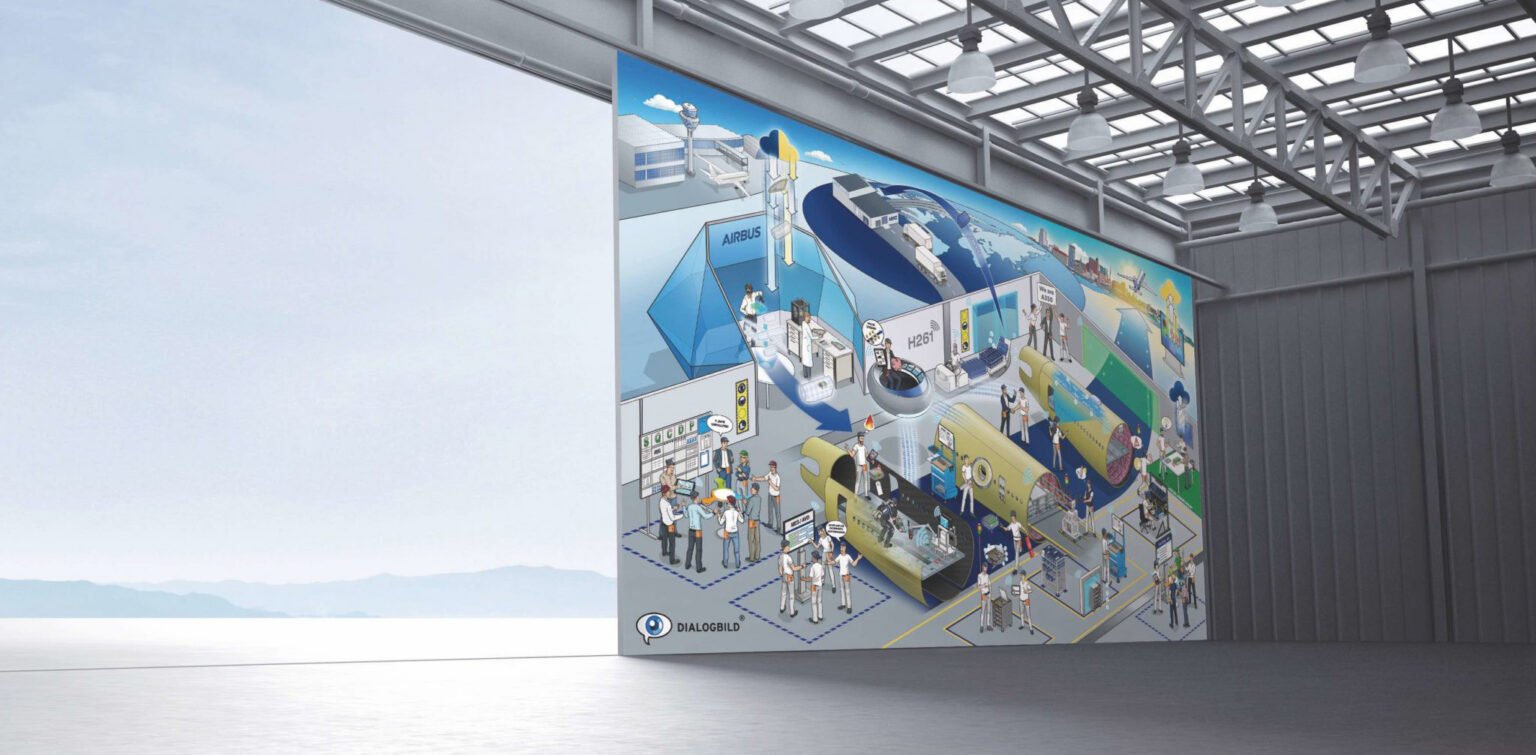
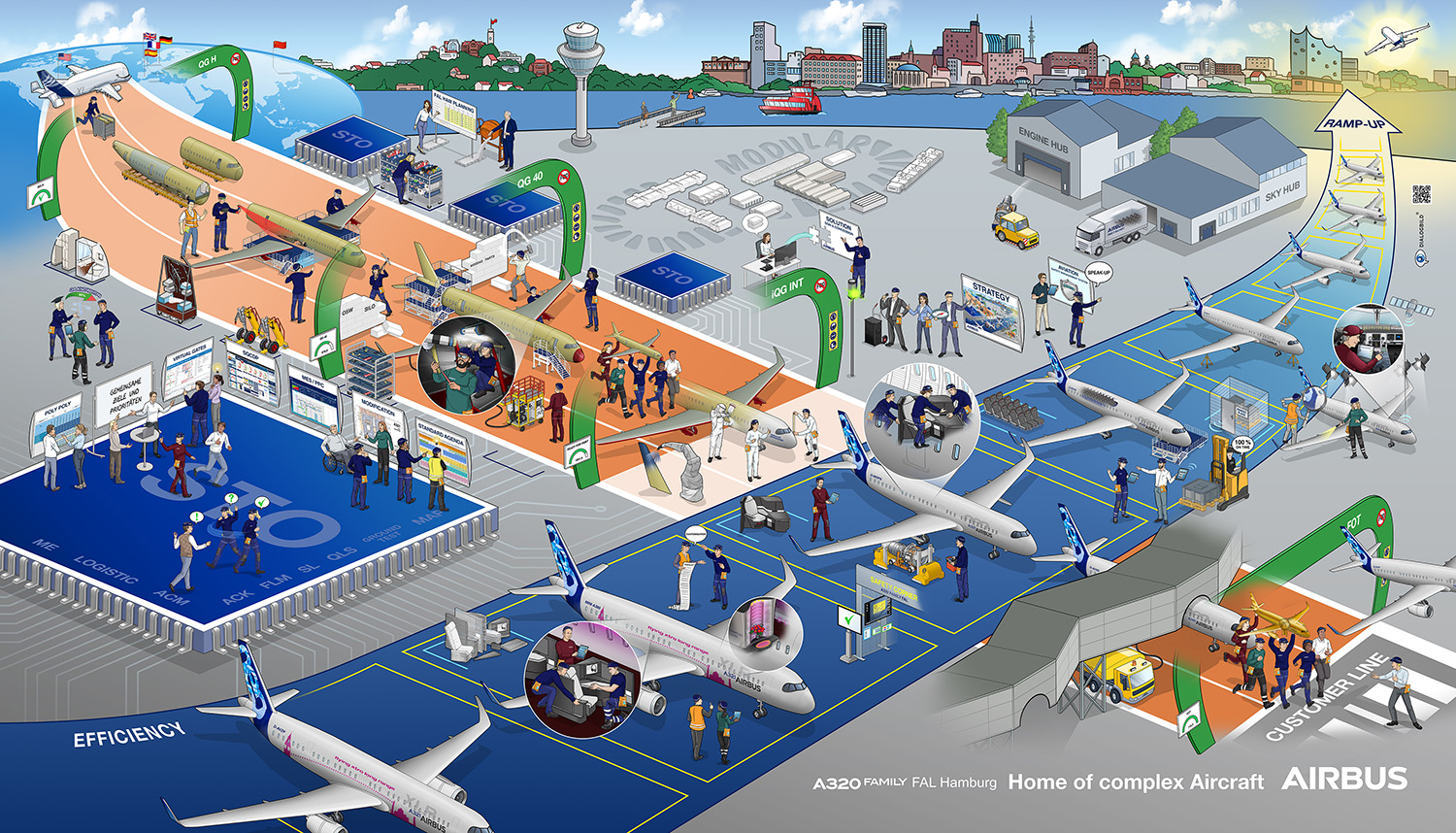
The Airbus plant in Hamburg-Finkenwerder is the largest Airbus site in Germany. Among other things, this is where the final assembly of the well-known A320 family takes place. As part of an internal restructuring, sequential line production is being converted to a mixed production organization, with the first half of production taking place in a synchronized area and the second half at a modular station. This means that various activities per aircraft that currently take place at several stations will be carried out at a single station.
The new modular concept is to be made visually understandable to production employees with the aid of a dialog picture, and the advantages and opportunities for all those involved are to be highlighted.
During a comprehensive tour of the factory, the DIALOGBLD team had everything shown to them in detail and took photos so that the individual machines and production steps could be depicted as authentically as possible in the final dialog picture.
The finished dialog picture will be displayed prominently in the production halls for everyone to see and will be used for internal workshops. ...
SINGLE AISLE EQUIPMENT ASSEMBLY 2.0
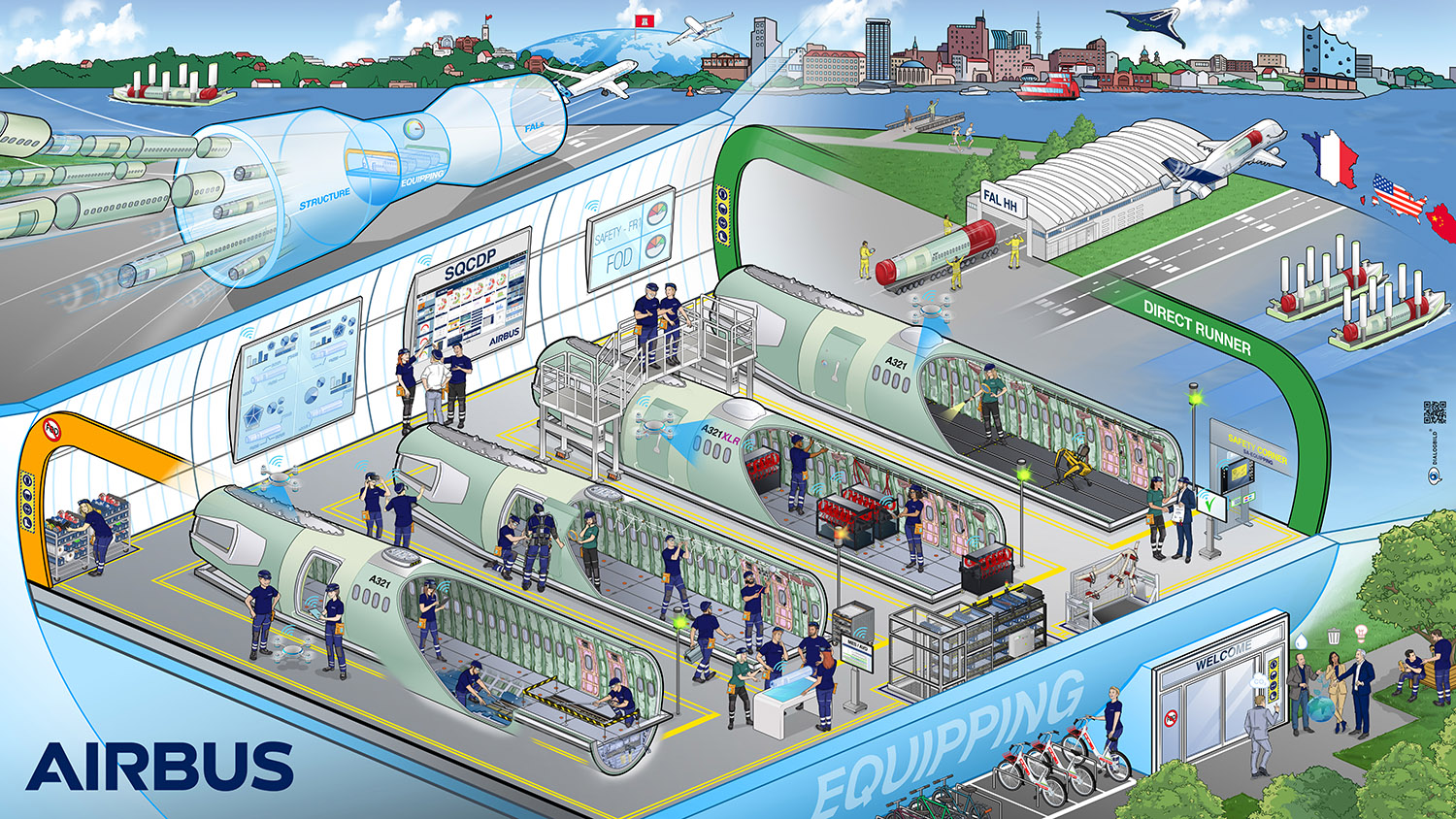
Aircrafts of the A320-family from Airbus are among the best selling aircraft worldwide. The depicted A321 model is a single aisle airplane with a capacity of up to 240 passengers and a range of up to 5,500 kilometers. As XLR-variant the airplane, equipped with additional tanks, is meant to reach a range of up to 8,700 kilometers. As final member within the Airbus Aerostructures GmbH in the location Hamburg-Finkenwerder, our picture depicts the entire system installation in the rear part of the assembly section and the further handover to Airbus FALs (Final Assembly Lines) in Germany, France, China and the USA. ...
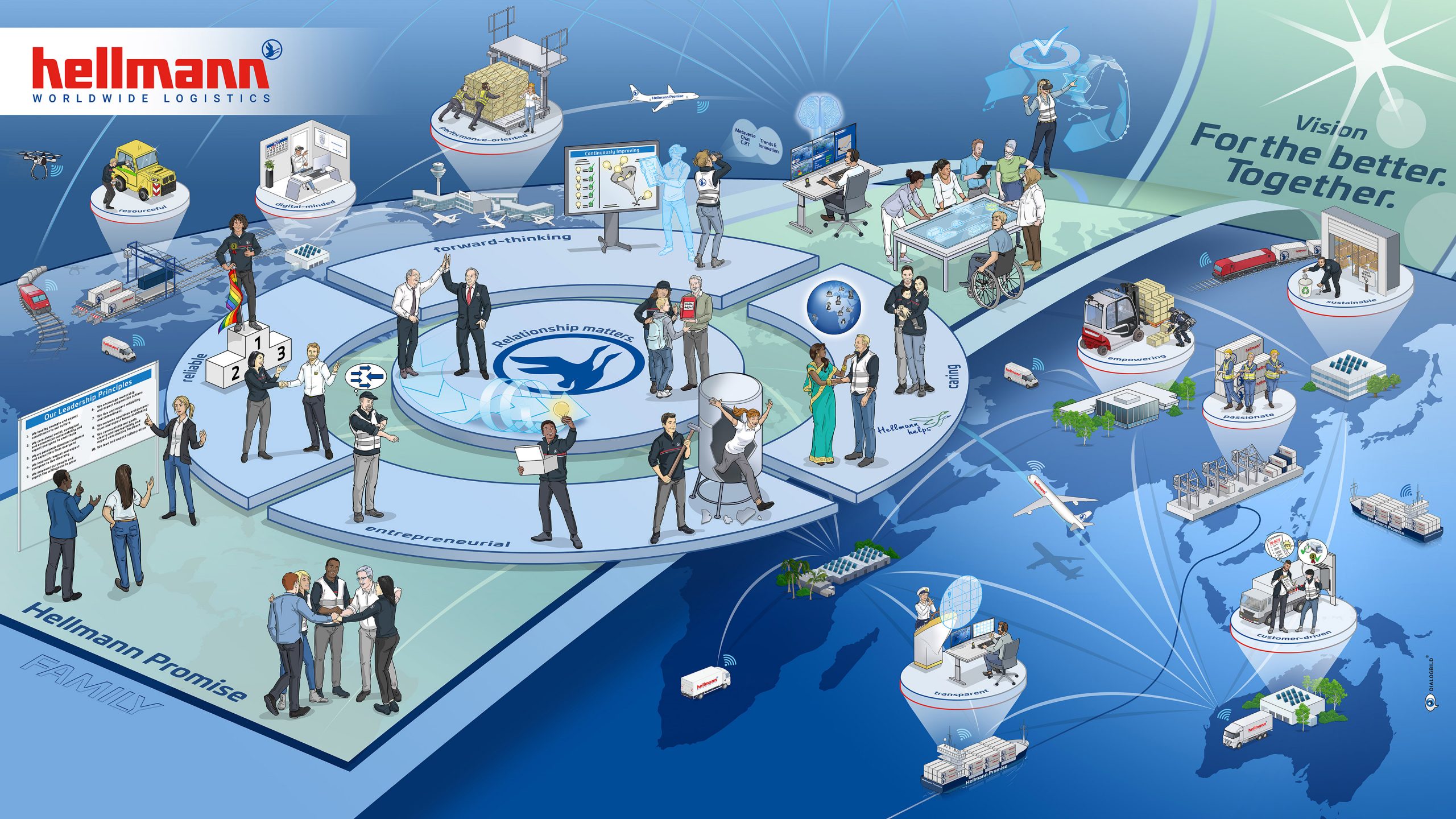
HELLMANN PROMISE
For more than 150 years, the family-owned company Hellmann Worldwide Logistics has successfully delivered top performance across a broad range of services - freight forwarding services by rail, truck, air and sea freight are complemented by CEP services, contract logistics and industry and IT solutions. What began with the transport of goods by horse and cart has evolved over the decades with technical innovations into state-of-the-art solutions.
To enable Hellmann Worldwide Logistics to meet the challenges of tomorrow, interdisciplinary work is already underway today on new visions. In order to position the company for sustainable success in times of constant change, a new corporate culture was defined, including a vision, mission and values. This globally valid culture, which connects all 14,000 employees, was to be conveyed in the dialog image and at the same time provided with a basic clarity.
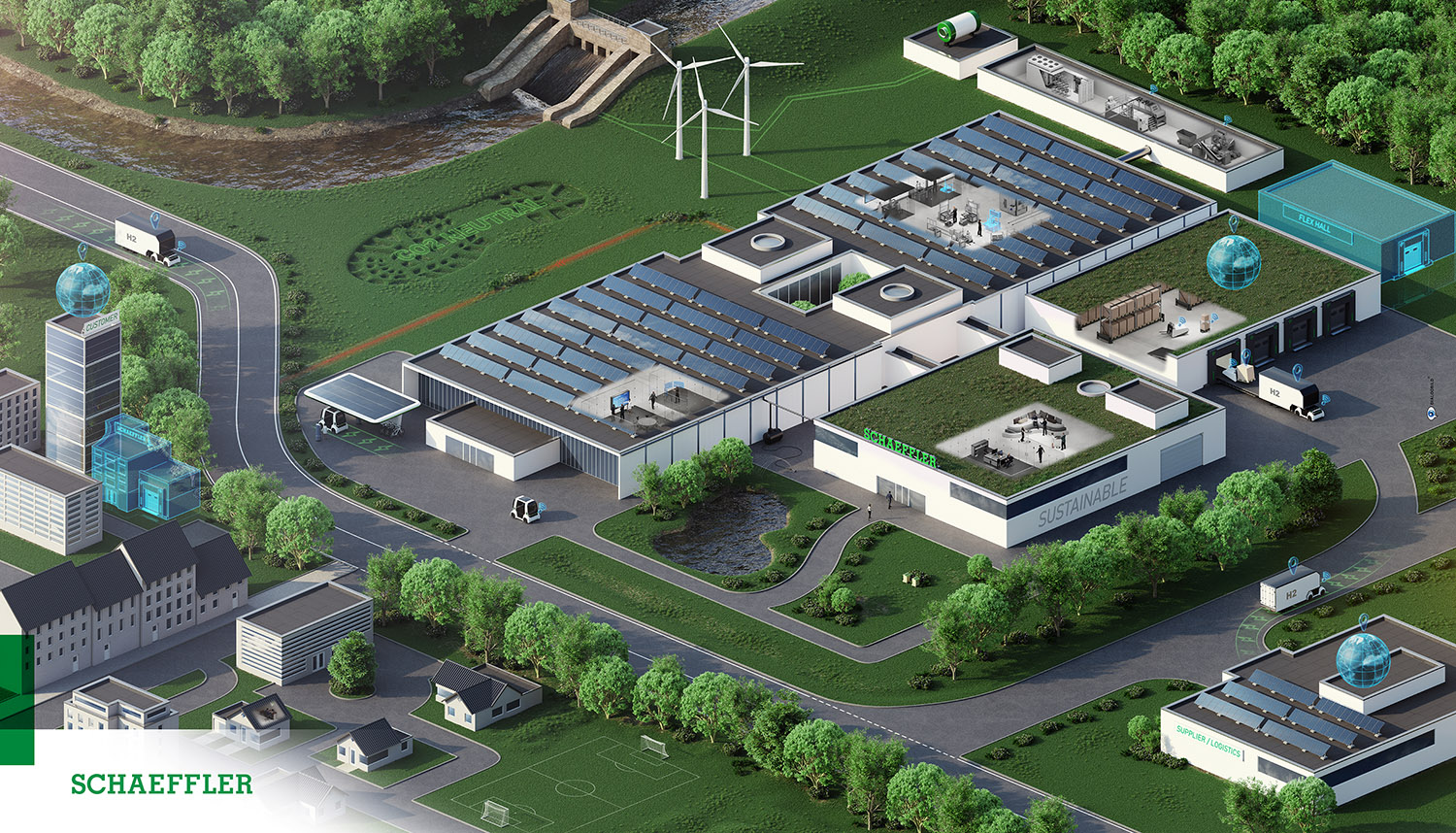
AUDI LOGISTICS
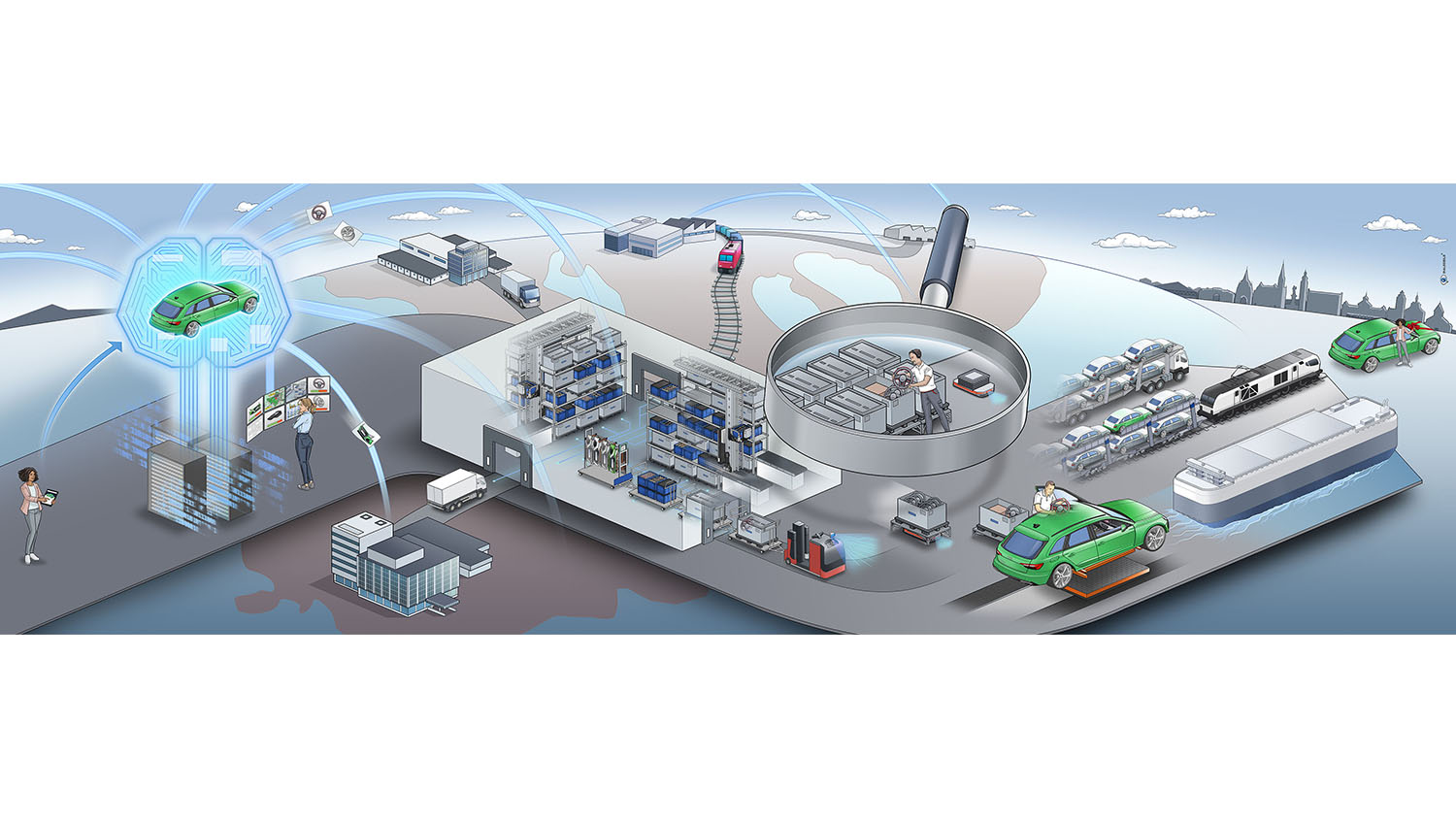
"The aim of this project was to give visitors to the Audi plant in Ingolstadt an understanding of the activities and functions of the supply chain. The challenge was to depict the complex and partly invisible processes of the supply chain as well as the extensive areas of responsibility in a structured and clearly understandable way for our visitors.
With the help of DIALOGBILD, we were able to capture our process descriptions holistically in a unique image composition, allowing all departments of the supply chain to identify together as a team."
Beate Schneeberger
Supply Chain Ingolstadt
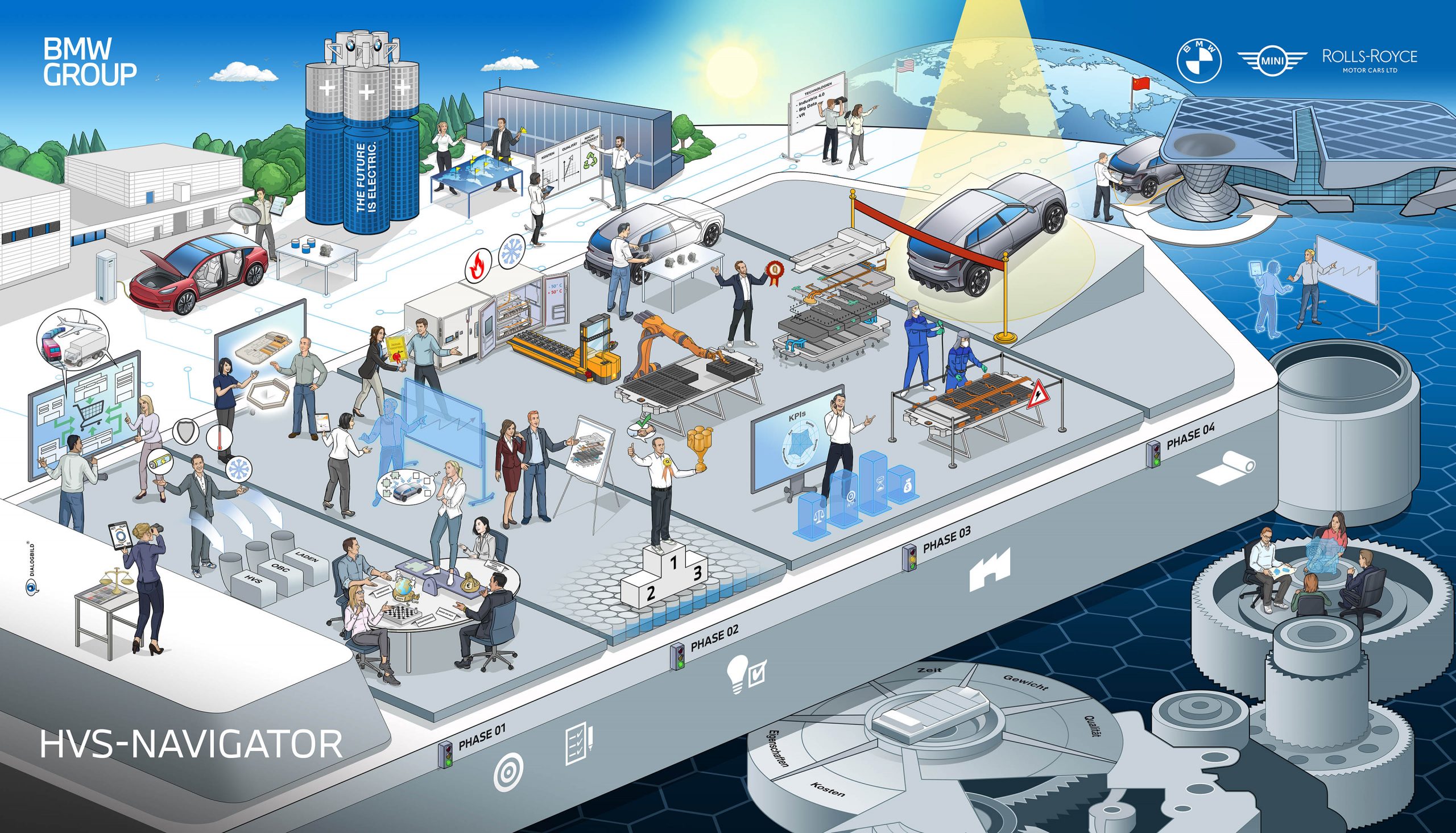
E-DRIVE DEVELOPMENT
THINKING ABOUT TOMORROW'S OPPORTUNITIES
With 31 production and assembly plants in 15 countries, the BMW Group is today one of the world's leading premium car manufacturers. The BMW Group is responding to the current age of electric mobility with clear and forward-looking visions of electric cars that are already thinking about the possibilities of tomorrow. The processes along the way are complex and require coordinated and targeted development steps. ...
FAQ: Frequently asked questions about process visualization in the defense industry
How does a dialog picture differ from classic Lean Management or swimlane diagrams?
Classic process diagrams (such as BPMN, Visio, or swimlanes) are highly abstract and usually only readable by Lean experts or process engineers. While they show the logical sequence, they neglect the human factor and the context. A dialog picture translates these dry data graveyards into a vibrant, visual map. It not only shows what needs to be done but also depicts the real work environments, the interfaces between departments, potential sources of error, and emotional barriers. This makes the process understandable to every employee—from strategic purchasing to the assembly line—at a glance.
How does the dialog picture method specifically help to improve supply chain resilience?
Resilience arises from transparency and rapid action in a crisis. If supply chains break down or components are held up due to export restrictions (e.g., ITAR/EAR), the alternative processes must be implemented immediately. In a resilient dialog picture, we visualize the entire ecosystem, including all single points of failure and buffer stocks. The workforce sees, visually anchored, which "Plan B routes" and emergency processes are defined. This sharpens proactive risk awareness and prevents costly production downtime because everyone knows their role in crisis management.
Can the dialog picture method also map complex government regulations, such as the procurement process of the German Armed Forces?
Yes, absolutely. The interfaces with government clients and the Federal Office of Bundeswehr Equipment, Information Technology and In-Service Support (BAAINBw) are highly formalized – for example, through Customer Product Management (CPM). The dialog picture acts as a translator here: We directly link the client's external, bureaucratic milestones and approval procedures with your internal milestones in development, logistics, and production. This allows project managers and engineers to immediately understand which documentation requirements and quality gates must be met at which point in time to avoid delaying the overall process.
How do we actively involve production staff in process optimization?
The greatest leverage for efficiency gains lies with the shop floor personnel. Ideally, a dialog picture is not just presented from above, but serves as an interactive tool. Large printouts in shop floor management or digital terminals encourage teams to discuss the current state. Employees can point directly to the image: "Material regularly backs up here" or "We often lack the approval documents at this interface." This interactive image breaks down silo thinking and becomes a catalyst for the continuous improvement process (CIP), as all participants are discussing the same visual reality.
Our defense company has extremely specific and highly confidential value streams. How does the collaboration work?
As an experienced agency, we understand the stringent security requirements of defense technology. In our collaborative process, you don't need to disclose any secret technical design data or confidential production figures. We abstract your processes to a logical level and utilize functional metaphors and symbols. Collaboration takes place through structured, secure workshops. Our editors and illustrators are trained to visualize complex value streams in a way that perfectly conveys the process logic while maintaining 100% know-how protection.
What digital possibilities does interactive process visualization offer?
Beyond traditional large-format printing for shop floor boards, the method unfolds its full potential digitally. We create interactive process applications (HTML5) that you can integrate into your intranet or enterprise systems. Users can zoom in deeper into individual production steps with a single click. Furthermore, real-time data (such as key performance indicators for throughput time, material stock levels, or quality rates) can be directly integrated into the visual stations of the dialog picture via interfaces. This transforms the picture into an intuitive, visual control center for your processes.
Get info package