
OpEx (Operational Excellence): The sustainable path to maximum value creation and operational excellence
Today’s global markets demand an unprecedented level of adaptability from businesses. Increasing competitive pressure, complex supply chains and the constant need to optimise costs whilst maintaining the highest quality present managers with enormous challenges. To remain competitive in the long term in this dynamic environment, it is no longer enough to implement one-off cost-cutting measures. What is required is a holistic, strategic approach: OpEx (Operational Excellence).
This guide explains in detail how to embed OpEx (Operational Excellence) within your organisation, which methods are essential, and how to actively engage your workforce in this process. You will also learn how the agency DIALOGBILD uses visual tools to make complex change processes tangible and understandable.
What exactly does OpEx (Operational Excellence) mean?
OpEx (Operational Excellence) refers to the continuous, systematic alignment of all business processes with customer needs – with the aim of achieving maximum efficiency, the highest quality and minimal waste. OpEx is not a temporary project with a fixed end date, but a corporate philosophy put into practice.
The overarching goal is operational excellence. This is characterised by the fact that processes are not only optimally documented in theory, but are also understood, practised and improved on a day-to-day basis by all staff members, who take personal responsibility for this. A functioning OpEx culture seamlessly links strategic guidelines from senior management with operational execution at the grassroots level.
An overview of the key objectives of OpEx:
- Customer focus: Aligning all activities with the actual added value for the customer.
- Increasing efficiency: Reducing lead times, rework and unnecessary interfaces.
- Minimising errors: Increasing process stability and the quality of products and services.
- Cultural change: Establishing an environment in which problems are seen as opportunities for improvement.
The Four Crucial Pillars of Operational Excellence
To successfully establish OpEx (Operational Excellence), the methodology relies on a comprehensive system of proven management approaches. Each of these tools addresses specific requirements in the transformation process.
1. Lean Management: Consistently Eliminating Waste
Lean Management forms the functional basis of many OpEx initiatives. Originally developed in automotive manufacturing, the Lean approach can now be applied to all areas of a company – from production to administration. The focus is on optimizing value creation processes and eliminating all forms of waste (Japanese: Muda).
Typical types of waste include:
- Unnecessary waiting times and transport routes
- Overproduction and excessive inventory
- Deficient processes that lead to error correction
- Unused potential and knowledge of employees
By aligning your processes with the principles of Lean Management, you create lean, transparent, and customer-centric value streams.
2. Kaizen: The Process of Continuous Improvement
While Lean Management creates the structures, Kaizen provides the intrinsic motivation. Kaizen is derived from the Japanese words Kai (change) and Zen (for the better). It describes the attitude that no day should pass without a small optimization.
Unlike radical restructuring, Kaizen focuses on continuous, incremental improvements that are directly implemented by the working teams. This fosters a culture of self-responsibility: employees don't wait for instructions from above, but rather identify bottlenecks independently and develop practical solutions.
3. Six Sigma: Maximum Quality Through Data-Driven Precision
While Lean Management primarily focused on speed and flow, Six Sigma provides the necessary measurement accuracy. Six Sigma is a highly structured method for process improvement based on statistical analysis.
Using the so-called DMAIC cycle (Define, Measure, Analyze, Improve, Control), the root causes of process deviations are systematically isolated and eliminated. The combination of Lean and Six Sigma (often referred to as Lean Six Sigma) guarantees that your processes are not only fast, but also extremely reliable and error-free – a key building block for sustained operational excellence.
4. Shopfloor Management: Effective Leadership at the Point of Action
The best strategy fails if it doesn't reach the front lines. This is where shopfloor management comes in. "Shopfloor" refers to the location of actual value creation – be it the assembly hall, the service center, or the development office.
With shopfloor management, managers shift their focus directly to the teams' workstations. Through regular, short huddles in front of visual KPI boards, current performance data, deviations, and disruptions are discussed transparently. Problems are not swept under the rug, but immediately prioritized and resolved within the team. This sustainably strengthens communication between management and employees.
The 4 pillars of OpEx in a methodological comparison
| Method | Main focus | Primary Goal |
Typical instruments |
| Lean Management | Value Stream & Flow | Avoiding waste | 5S, Value Stream Mapping, Kanban |
| Kaizen | Corporate culture | Continuous small steps | KVP-Workshops, Gemba Walks, Ideamanagement |
| Six Sigma | Quality & Variety | Error-free processes through data | DMAIC cycle, control charts, statistical tests |
| Shopfloor Management | Leadership & Communication | Transparency & quick response | Visual boards, daily huddles, go-look-see |
Why Many OpEx Initiatives Fail: The Barrier of Abstract Communication
Although the theoretical benefits of OpEx (Operational Excellence) are undeniable, many change projects fizzle out. The cause is rarely a lack of tools or flawed data. The primary reason is almost always inadequate communication.
Transactional changes create uncertainty. When employees are confronted with incomprehensible jargon, complex flowcharts, and endless Excel spreadsheets, resistance arises instead of enthusiasm. Human brains are not designed to translate abstract process chains from text documents into motivating action. Without a shared strategic vision, the transformation remains a purely theoretical project.
How DIALOGBILD Leads Your OpEx Transformation to Success
DIALOGBILD supports you at this critical interface. We bridge the gap between highly complex operations strategies and your employees' daily work. For many years, we have been developing customized visual tools that make complex relationships understandable, relatable, and emotionally engaging.
1. Translating Complex Processes into Visual Maps: We transform your OpEx strategy, your Lean Management principles, and your quality objectives into a customized visual overview—a so-called dialog picture. Instead of dry guidelines, your teams receive a detailed, illustrative panorama of their work environment. Each individual immediately sees how their actions contribute to overall success and where there is potential for improvement.
2. Activating the Workforce Through Guided Dialogues: A dialog pictureis not a passive poster for the hallway wall. It is a highly effective tool for interactive workshops. Managers use the visual landscape to develop change processes in dialogue with their teams. Visual language breaks down hierarchical barriers, stimulates discussion, and fosters a shared understanding of the necessity of Kaizen and shop floor management.
3. Sustainable Integration on the Shop Floor: We also create specific visual guides, process diagrams, and documentation for your shop floor management. This simplifies onboarding processes, increases compliance with standards, and ensures that the principles of operational excellence remain present in daily workflows.
4. Building Bridges Between Departments: OpEx requires breaking down silo thinking. Through the holistic representation of the entire value stream, employees from interface areas (e.g., sales, purchasing, production, IT) gain a visual understanding of the challenges faced by other teams for the first time. This promotes mutual understanding and dramatically accelerates the flow of information across departments.
Suggestions for visual elements in this article
For optimal presentation of this article in your CMS, we recommend the following visual media:
- Header graphic: An appealing vector graphic depicting a team working together on a visual process map.
- Infographic (pillar model): A graphic representation of the four pillars of OpEx (Lean, Kaizen, Six Sigma, Shopfloor) as the supporting pillars of a successful company.
- Example illustration from the agency DIALOGBILD: A high-resolution image excerpt from a real Dialogbild (dialogue image) demonstrating how an optimized value stream can be visually represented.
- Explainer video integration: An embedded short video (1–2 minutes) demonstrating the Dialogbild method in use during transformation processes.
Start your transformation to operational excellence now!
Excellent processes don't arise from top-down directives, but from the shared understanding of all involved. With OpEx (Operational Excellence), you create the foundation for sustainable success, agile processes, and engaged teams.
Leave complex strategy documents behind and make your goals tangible for everyone in your company. At DIALOGBILD, we support you with tailored visual solutions to bring your change processes to life.
STRATEGY MAP: SINGLE AISLE
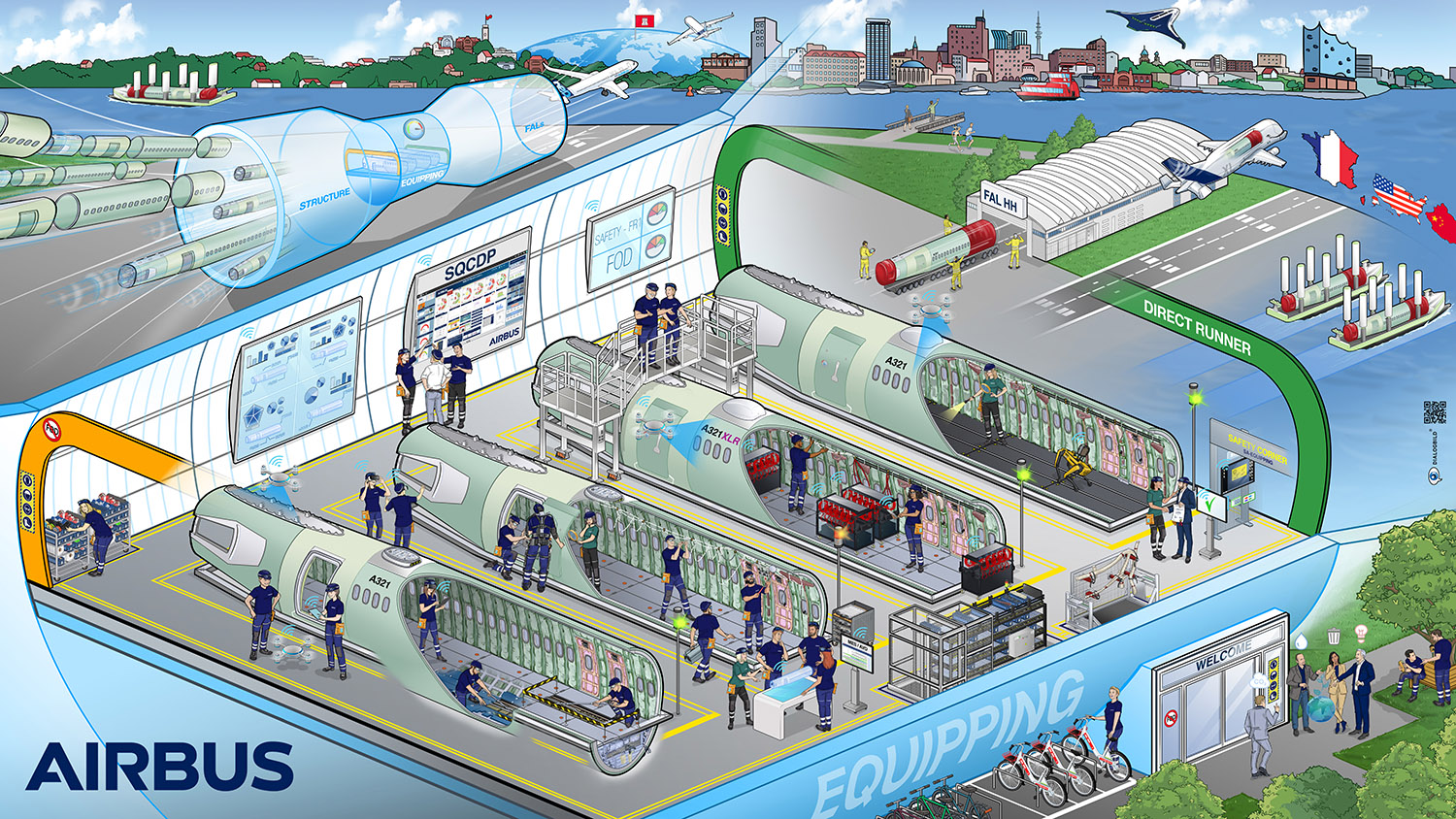
Aircrafts of the A320-family from Airbus are among the best selling aircraft worldwide. The depicted A321 model is a single aisle airplane with a capacity of up to 240 passengers and a range of up to 5,500 kilometers. As XLR-variant the airplane, equipped with additional tanks, is meant to reach a range of up to 8,700 kilometers. As final member within the Airbus Aerostructures GmbH in the location Hamburg-Finkenwerder, our picture depicts the entire system installation in the rear part of the assembly section and the further handover to Airbus FALs (Final Assembly Lines) in Germany, France, China and the USA. ...
A DIALOG PICTURE FOR AIRBUS AND THEIR NEW MODULAR CONCEPT
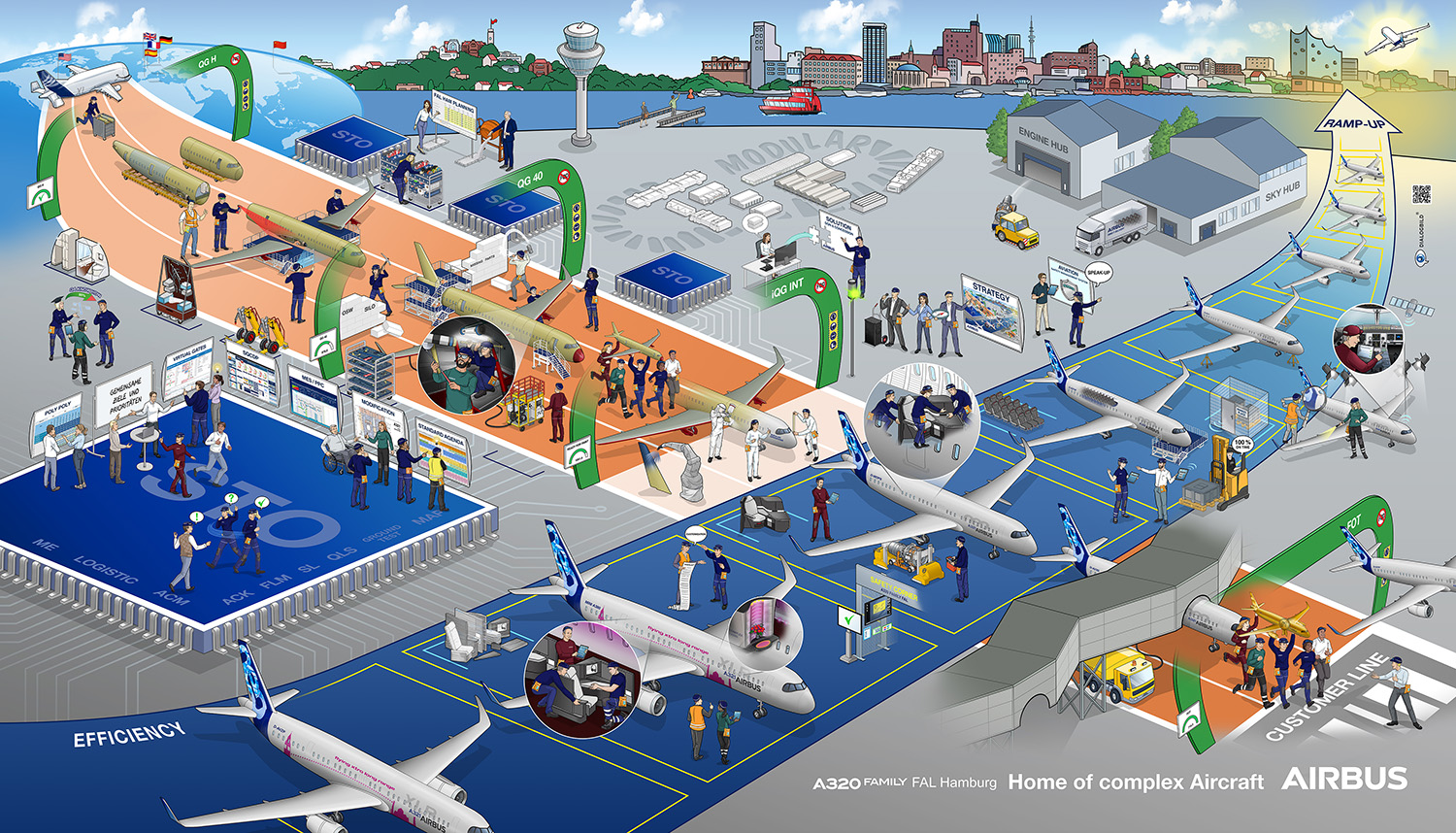
The Airbus plant in Hamburg-Finkenwerder is the largest Airbus site in Germany. Among other things, this is where the final assembly of the well-known A320 family takes place. As part of an internal restructuring, sequential line production is being converted to a mixed production organization, with the first half of production taking place in a synchronized area and the second half at a modular station. This means that various activities per aircraft that currently take place at several stations will be carried out at a single station.
The new modular concept is to be made visually understandable to production employees with the aid of a dialog picture, and the advantages and opportunities for all those involved are to be highlighted.
During a comprehensive tour of the factory, the DIALOGBLD team had everything shown to them in detail and took photos so that the individual machines and production steps could be depicted as authentically as possible in the final dialog picture.
The finished dialog picture will be displayed prominently in the production halls for everyone to see and will be used for internal workshops. ...
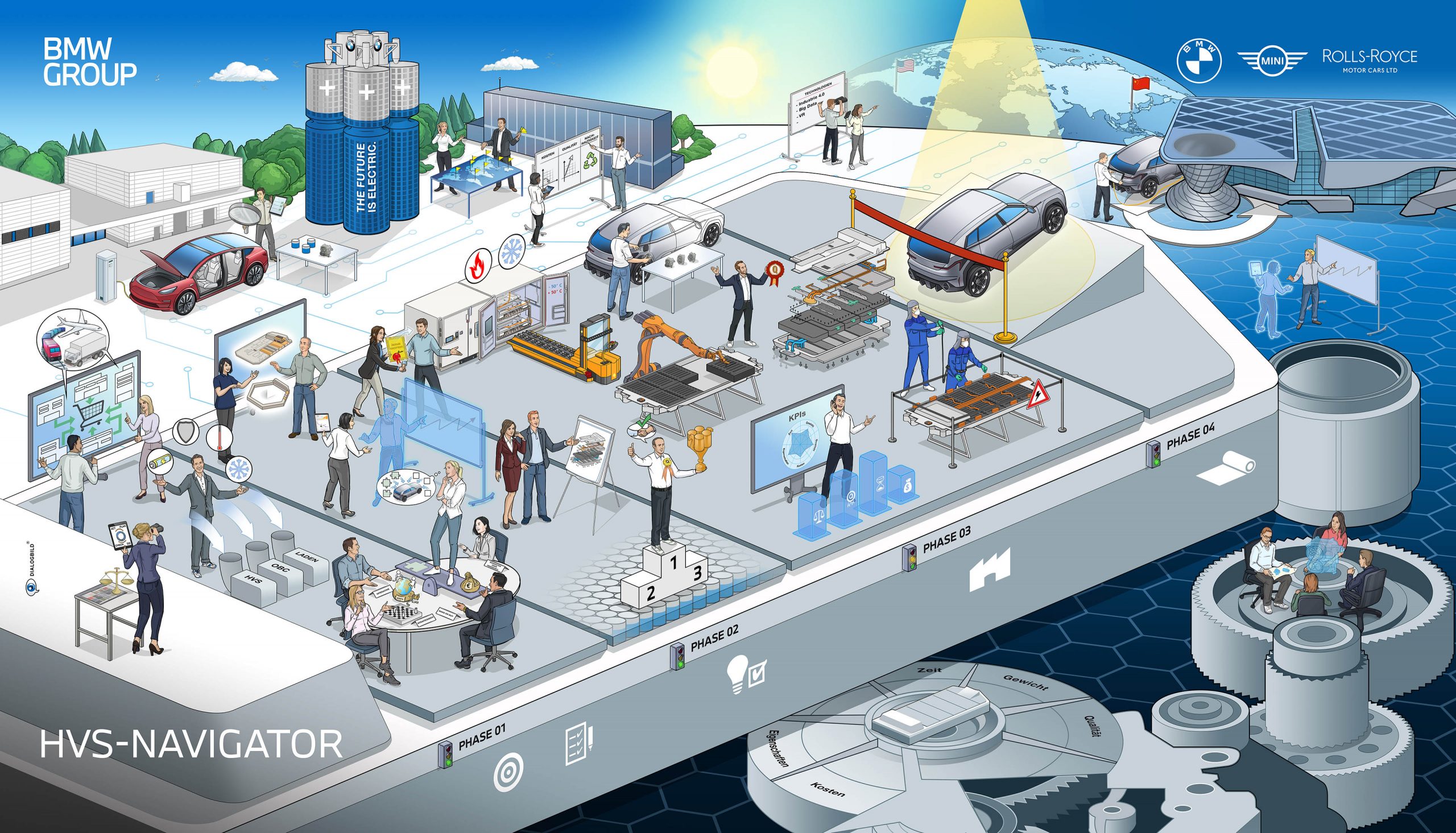
E-DRIVE DEVELOPMENT
THINKING ABOUT TOMORROW'S OPPORTUNITIES
With 31 production and assembly plants in 15 countries, the BMW Group is today one of the world's leading premium car manufacturers. The BMW Group is responding to the current age of electric mobility with clear and forward-looking visions of electric cars that are already thinking about the possibilities of tomorrow. The processes along the way are complex and require coordinated and targeted development steps. ...
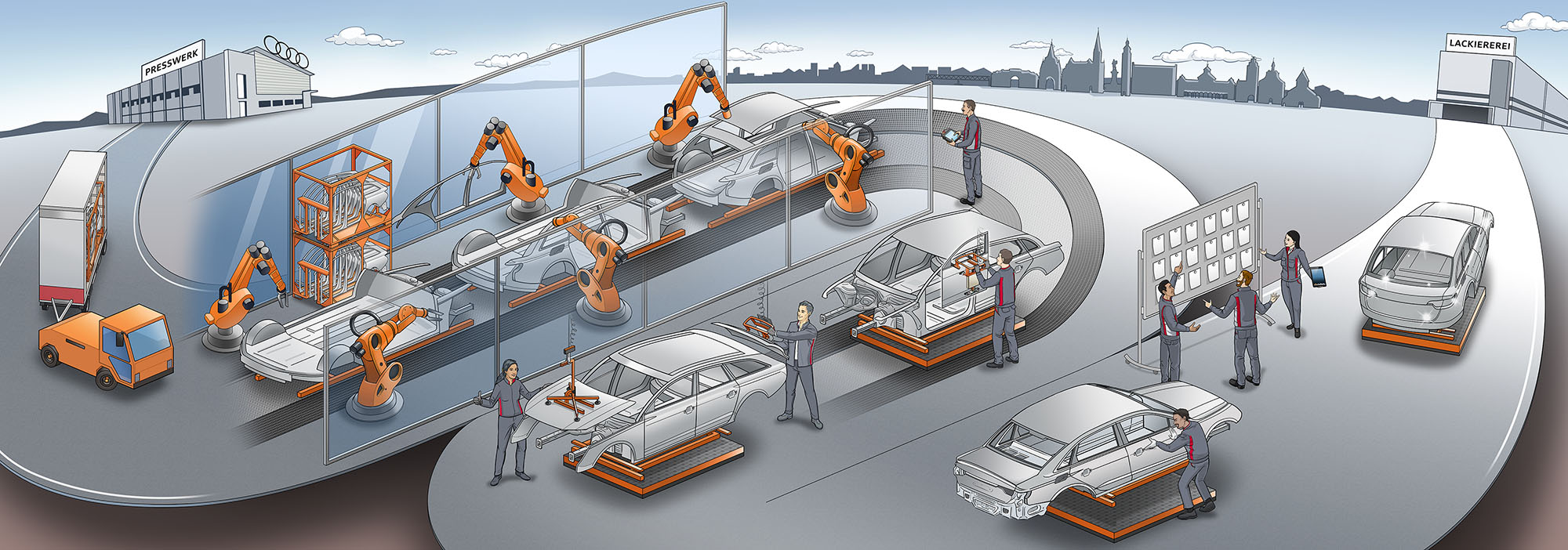
AUDI INGOLSTADT: CAR BODY CONSTRUCTION AT A GLANCE
Future is an attitude …
... a vision that more than 43,000 employees in Ingolstadt alone work on effectively and with passion. For more than 70 years, well-known models have rolled out of production all over the world. Enthusiastic customers can follow the basic principles of production on a guided tour of the plant. When designing the visitor route, the company once again opted for a dialog picture to visualize the individual processes of production in the body shop. The processes and interrelationships can be grasped at first glance and are presented in an easily understandable way from a bird's eye view.
In the process, the content of the dialog picture was developed in several web conferences. Together with an illustrator and consultant from DIALOGBILD and a team from AUDI AG under Christopher Nussbaum's leadership, the topics were developed and partially sketched live. In this way, all participants could be actively involved in the development process and had the opportunity to help shape the dialog picture. After the final fine-tuning of the content, the dialog image was finally visualized in color and in a high level of detail.
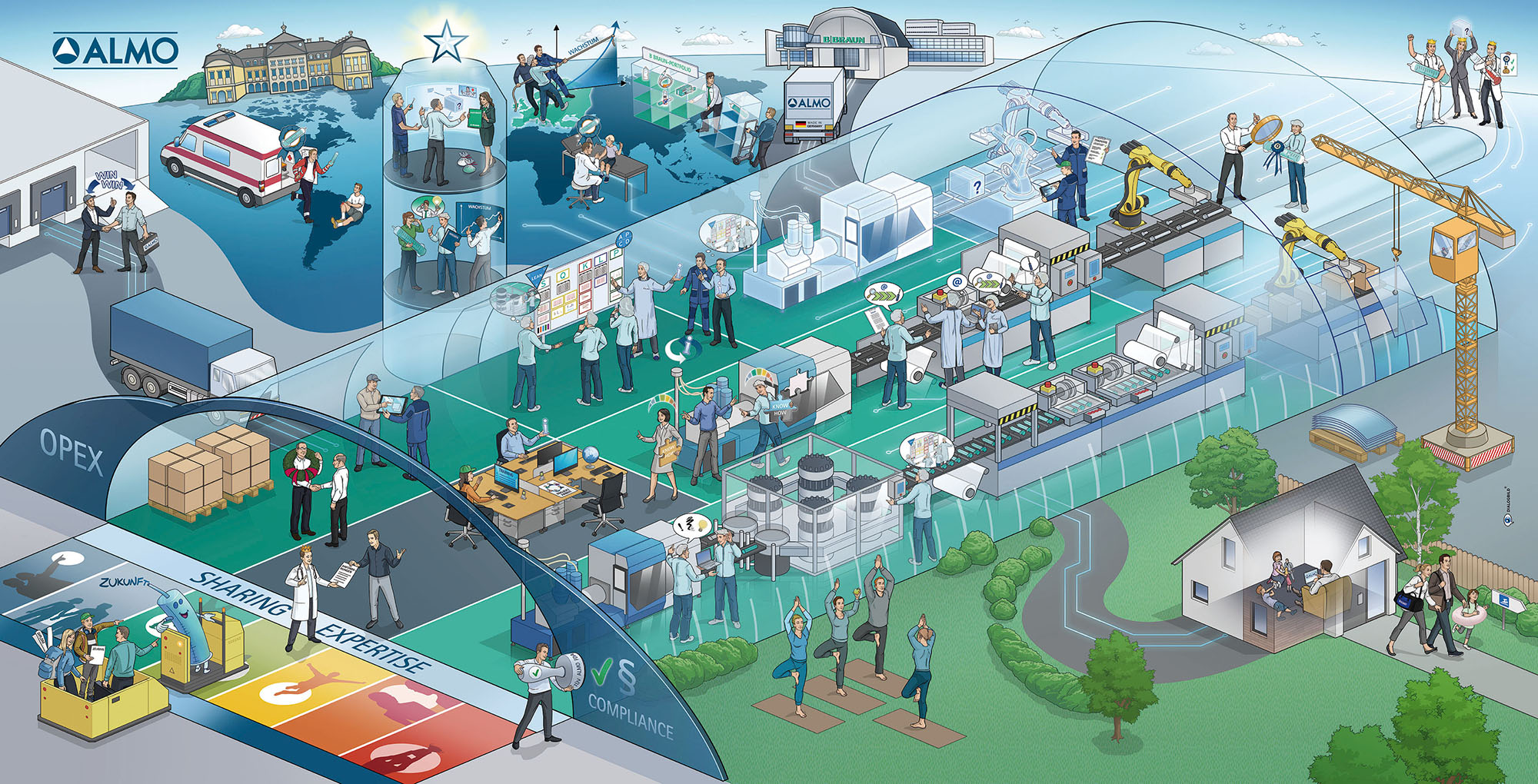
THE TARGET PICTURE
Creating transparency about the target system, making it understandable and easy to communicate to all employees, providing the opportunity for personal identification and describing the way into the future to ultimately provide a higher-level orientation for the entire company - these were the reasons why ALMO decided to create a dialog picture.
Together with DIALOGBILD and Goldpark as professional partners, a dialog picture was developed and implemented for ALMO. During the first step, the already existing target system was supplemented by a „north star“ and derived core statements. This creative process was moderated and supported by Goldpark.
The target picture was developed on the basis of the „north star“, key messages and ALMO's strategy and corporate mission statement. It was important for the company to integrate employees and executives into the development process. Therefore, executives and employees of all departments as well as members of the works council participated in three workshops.
The target development workshops were presented by DIALOGBILD in an open and integrating way. The participants were able to voice their opinion and their thoughts and DIALOGBILD managed to enthuse everyone - including the critics - for the target picture and ensure the personal identification with the images content. This created a positive undertone for the target picture even before its official implementation.
DIALOGBILD provided the ideas for the implementation of the target picture as part of an interactive event and also supported ALMO during the event. Goldpark was an important source of ideas, especially in the development of the target pictures content, the description of the „north star“ as well as preparing the executives for the target picture implementation.
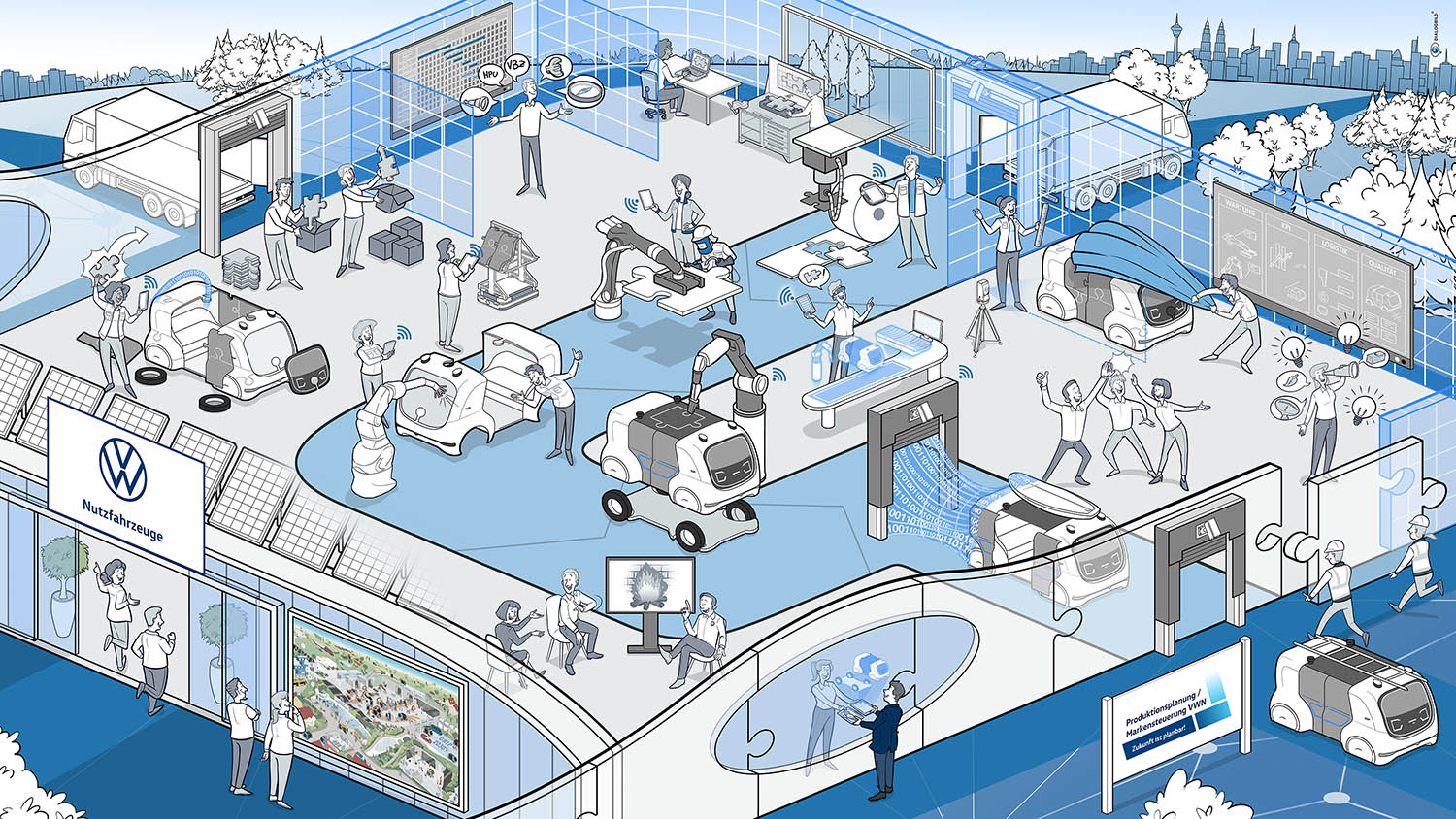
SMART PLANNING - THE FACTORY OF THE FUTURE
With over 1,000 employees, Production Planning / Brand Management VWN makes a decisive contribution to the long-term corporate success of the Volkswagen Commercial Vehicles brand.
The department is responsible for shaping the production of tomorrow. Interdisciplinary teams develop concepts for the implementation of new vehicle projects. In addition to influencing products towards a production-oriented product design, the department also focuses on the production and on-time provision of systems and components.
As part of the strategy work, a visual world was developed in collaboration with DIALOGBILD that focuses on the interaction of the individual departments and the common goal of a SMART PLANNING factory.
The communication medium designed for the employees of the division represents the variety of tasks and responsibilities of the individual departments. In this way, the employees' identification with the target image of the division as well as with their own area of responsibility is to be strengthened.
FAQ: Frequently Asked Questions about OpEx (Operational Excellence)
1. What is the fundamental difference between OpEx and cost reduction programs? Traditional cost reduction programs are usually short-term and focus solely on reducing expenditures—often at the expense of resources or quality. OpEx (Operational Excellence), on the other hand, is a long-term strategy. It sustainably optimizes value chains by eliminating waste and errors. With OpEx, cost reduction is the automatic result of improved processes, not the sole primary control mechanism.
2. What is the relationship between Lean Management and Six Sigma? Lean Management and Six Sigma complement each other perfectly. While Lean Management focuses on eliminating waste, simplifying processes, and shortening lead times, Six Sigma concentrates on the statistical reduction of process deviations and errors. Together, as Lean Six Sigma, they form a comprehensive methodology for fast and extremely error-free operations.
3. How can Kaizen be integrated into everyday work? Kaizen is integrated into daily work by managers creating a culture that embraces mistakes and providing dedicated spaces for improvement suggestions. This includes short daily CIP (Continuous Improvement Process) meetings, visual idea boards at the workplace, and the rapid feedback and implementation of employee ideas. It's important that even small improvements are immediately recognized and appreciated.
4. Does shop floor management also work in the service sector or in offices? Yes, absolutely. Even though the term originates from manufacturing, shop floor management (often also called floor management or office management) can be perfectly applied to administrative areas, software development, or service providers. Instead of physical components, processes, tickets, or project statuses are discussed on visual boards (digital or analog) to identify bottlenecks early on.
5. How long does it take for OpEx successes to become visible? Initial operational successes and improvements often become apparent after just a few weeks through targeted Kaizen workshops or the introduction of shop floor huddles. However, the complete transformation of the corporate culture toward true operational excellence is an ongoing process that typically requires one to three years of intensive work, depending on the company size.
6. Why is visual communication so crucial in change processes? People process visual information up to 60,000 times faster than text alone. Visual representations, such as dialog pictures, break down complex relationships into easily understandable scenes. They create a clear, shared understanding, reduce anxieties about change, and enable dialogue on equal footing across all hierarchical levels.
7. How does the agency DIALOGBILD support specific OpEx initiatives? DIALOGBILD works with your experts to develop customized visual strategy landscapes and working materials. We translate abstract key performance indicators, Lean guidelines, and target states into compelling visual worlds. This actively involves your employees in workshops and daily operations, dramatically increasing the acceptance and speed of implementation of your OpEx measures.
Get info package