
Change Management: Your Ultimate Guide to Successful Change Processes

As a manager, change manager or HR professional, you know that change processes within organisations are inevitable and often involve significant challenges. Digital transformation, new competitors or internal restructuring mean that organisations must constantly evolve. But how can you not only initiate these processes, but also shape them successfully, overcome resistance from staff and achieve sustainable results? This is where change management comes in!

This guide provides you with the tools to master change management both strategically and on a human level. We’ll show you how to understand the fundamentals, apply tried-and-tested models and avoid typical pitfalls. You’ll learn how to actively involve staff and develop change management strategies that will lead your organisation to a successful future

1. Introduction to Change Management

What is change management?

Change management encompasses all activities aimed at systematically and purposefully planning, steering and supporting change within an organisation. It involves implementing new strategies, structures, technologies or cultures in such a way that staff understand, accept and actively support this change.

It is far more than just a project plan or the announcement of new guidelines. It is a holistic approach that focuses on the human side of change. After all, the success of any change stands or falls with the people who have to live with it.

The Importance of Change Management

In today’s dynamic business world, the ability to adapt is crucial to a company’s survival and growth. Professional change management is key to:

  • Remaining competitive and responding quickly to market changes.
  • Increase efficiency and productivity.
  • Boost staff satisfaction and retention by actively involving them in the process.
  • Minimise risks arising from unmanaged or chaotic change.

Objectives of change management

The main objectives of change management are varied and always geared towards the organisation’s long-term success:

  • Building acceptance: Ensuring that staff understand the need for change and accept it.
  • Minimising resistance: Proactively addressing concerns and fears in order to identify and reduce resistance to change at an early stage.
  • Fostering engagement: Motivating the workforce to actively support and shape the change.
  • Ensuring sustainability: Embedding the change in such a way that it does not revert to old patterns of behaviour, but becomes part of the organisation’s ongoing development.

2. Phases of the change process

Change processes cannot simply be organised. They go through various phases, which need to be understood and managed in a targeted manner. Two of the best-known models that divide change into phases are those developed by Kurt Lewin and John P. Kotter.

Kurt Lewin’s 3-phase model

Kurt Lewin, a pioneer of social psychology, described the change process as a three-phase model:

  1. Unfreezing: In this phase, the need for change is recognised and communicated. The rigid structures and habits that maintain the status quo are ‘unfrozen’. The aim is to prepare people for the change and convince them of its urgency.
  2. Moving: Now the actual transformation begins. The new structures, processes and behaviours are implemented. This is the phase of uncertainty, during which staff require intensive support.
  3. Refreezing: Following implementation, the change must be stabilised and embedded in the organisational culture. The new behaviours and ways of working become the norm. This is crucial to prevent a relapse into old patterns.

John P. Kotter’s 8-step model

John P. Kotter’s model is a more detailed and practical change management strategy. It provides a clear roadmap for successfully managing change:

  1. Create a sense of urgency: Make it clear to everyone involved why the change is necessary.
  2. Build a powerful leadership coalition: Assemble a team of influential stakeholders to drive the change forward.
  3. Develop a vision and strategy: Formulate a clear vision for the future and a strategy for achieving it.
  4. Communicate the vision: Communicate the vision constantly and everywhere.
  5. Empower the wider workforce to take action: Remove obstacles and empower staff so that they can actively help shape the change.
  6. Aim for short-term successes: Achieve visible successes quickly to keep motivation high.
  7. Consolidate successes and initiate further changes: Use the initial successes to accelerate the change.
  8. Embed new approaches in the culture: Make the new behaviours an integral part of the corporate culture.

Both models offer valuable guidance, but in practice it is often a combination and adaptation of these approaches that leads to success.

3. Resistance to change

Resistance to change is a natural and inevitable reaction. It is not a sign of stubbornness, but often an expression of uncertainty, fear or a sense of losing control. Successful change management does not view resistance as an obstacle, but as valuable feedback.

Causes of resistance

The reasons for resistance can be varied:

  • Psychological causes: fear of the unknown, loss of status or power, lack of trust in leadership.
  • Organisational causes: poor communication, failure to involve staff, lack of resources or unclear objectives.
  • Personal causes: the belief that the change is unnecessary or impractical, concern for one’s own job security.

Strategies for overcoming resistance

Dealing with resistance requires empathy and a proactive approach. Proven strategies include:

  • Communication: Explain the ‘why’. Communicate the reasons for the change and the potential benefits openly, honestly and at an early stage.
  • Involvement: Actively involve staff in the change process. Give them a voice and the opportunity to help shape the change.
  • Training and support: Offer training and coaching to develop new skills and minimise uncertainty.
  • Empathy: Take concerns seriously and show understanding for staff’s fears.

Turning resistance into an opportunity

Resistance also acts as an early warning system. It can highlight weaknesses in the plan that you might otherwise have overlooked. If you use it as a feedback mechanism, you can adapt and improve your change management strategy. By understanding the causes of resistance, you can bring about a more sustainable and widely accepted change.

4. Change Management Strategies

Successful change management requires choosing the right strategy. There is no one-size-fits-all approach that suits every organisation and every situation. Rather, it is crucial to tailor the strategy to the specific needs and culture of your organisation.

Agile Approaches to Change

In an increasingly fast-paced world, rigid, long-term plans are often impractical. Agile approaches to change management focus on iterative, incremental adjustments. Instead of implementing a major, comprehensive change all at once, small, continuous improvements are introduced. This makes it possible to respond more quickly to feedback and minimise the risk of major setbacks. Such an approach is ideally suited to modern organisations striving for agile organisational development.

Top-down vs. bottom-up approaches

  • Top-down approach: Change is initiated by senior management and communicated downwards. This can be quick and efficient, but carries the risk that staff will feel sidelined and put up resistance.
  • Bottom-up approach: Change is driven by the staff themselves and grows from the grassroots upwards. This fosters engagement, but can be slow and uncoordinated.

The ideal approach is often a combination of both: management sets the strategic direction (top-down), whilst employees play an active role in implementation and working out the details (bottom-up).

Communication strategies in change management

Communication is at the heart of every successful change management strategy. An effective communication strategy should:

  • Be transparent: Make the objectives, timetable and implications of the change clear.
  • Be multi-channel: Use a variety of channels (emails, meetings, the intranet, face-to-face discussions) to ensure the message reaches everyone.
  • Be dialogue-oriented: Create opportunities for feedback and discussion. Communication is not a one-way street.

5. Measuring success in change management

How do you know if your change processes are successful? Measuring success is crucial for tracking progress, adjusting the strategy and underpinning the legitimacy of the change.

Key Performance Indicators (KPIs)

Define clear KPIs at the start of the project. These can be quantitative or qualitative in nature:

  • Quantitative KPIs: project milestones, adherence to budget, adherence to the timetable, increased productivity.
  • Qualitative KPIs: staff satisfaction (measured through surveys), acceptance of the new tools, reduction in complaints or resistance.

Feedback Mechanismus

Continuous feedback is essential. Set up channels through which staff can voice concerns, ask questions and make suggestions. Regular check-ins, workshops and anonymous surveys are valuable tools for gauging the organisation’s mood and responding to problems at an early stage.

Long-term impact of change

The true success of change management only becomes apparent in the long term. Assess whether the new behaviours and structures have been sustainably embedded in the organisation’s development. Has the culture changed for the better? Has the company become more resilient in the face of future challenges?

6. Case studies of successful change projects

To bring the theory to life, let’s look at some successful real-world examples.

Case study 1: Introducing agile working practices

A medium-sized software company faced the challenge of keeping pace with the market’s rapid innovation cycles. Rigid hierarchies and lengthy decision-making processes prevented a swift response.

  • Approach: Senior management opted for a bottom-up approach. Small, cross-functional teams were formed to work in agile sprints. Management communicated the vision for change, whilst the teams planned the practical implementation.
  • Result: Initial resistance to change, driven by uncertainty, was overcome through regular training and the visible, rapid successes achieved by the first teams. Employees felt they were shaping the change themselves, and productivity rose significantly.

Case Study 2: Merger of two companies

Two formerly competing companies merged, which posed a major challenge for organisational development. Their corporate cultures and working practices were fundamentally different.

  • Approach: A dedicated change management team was set up, which focused from the outset on transparent communication and building a shared identity. Joint workshops and mentoring programmes helped to build trust between the teams.
  • Result: Although the change process was protracted, a new, strong corporate culture was successfully established. By involving staff at an early stage and creating a shared vision, friction was minimised.

Key takeaways from the case studies

The most important lessons from successful projects:

  • People are at the heart of the process.
  • Communication is the key to success.
  • A clear vision and a strong leadership team are essential.
  • Change must be continuously monitored and measured.

7. How dialog picture can help with change management

You have learnt about the theory behind change management. But how do you put these complex processes into practice and make them tangible for your staff? This is where we, the DIALOGBILD agency, come in. Change processes often fail not because of the strategy, but because of the communication. Purely text-based information or endless PowerPoint slides can quickly be perceived as confusing or boring.

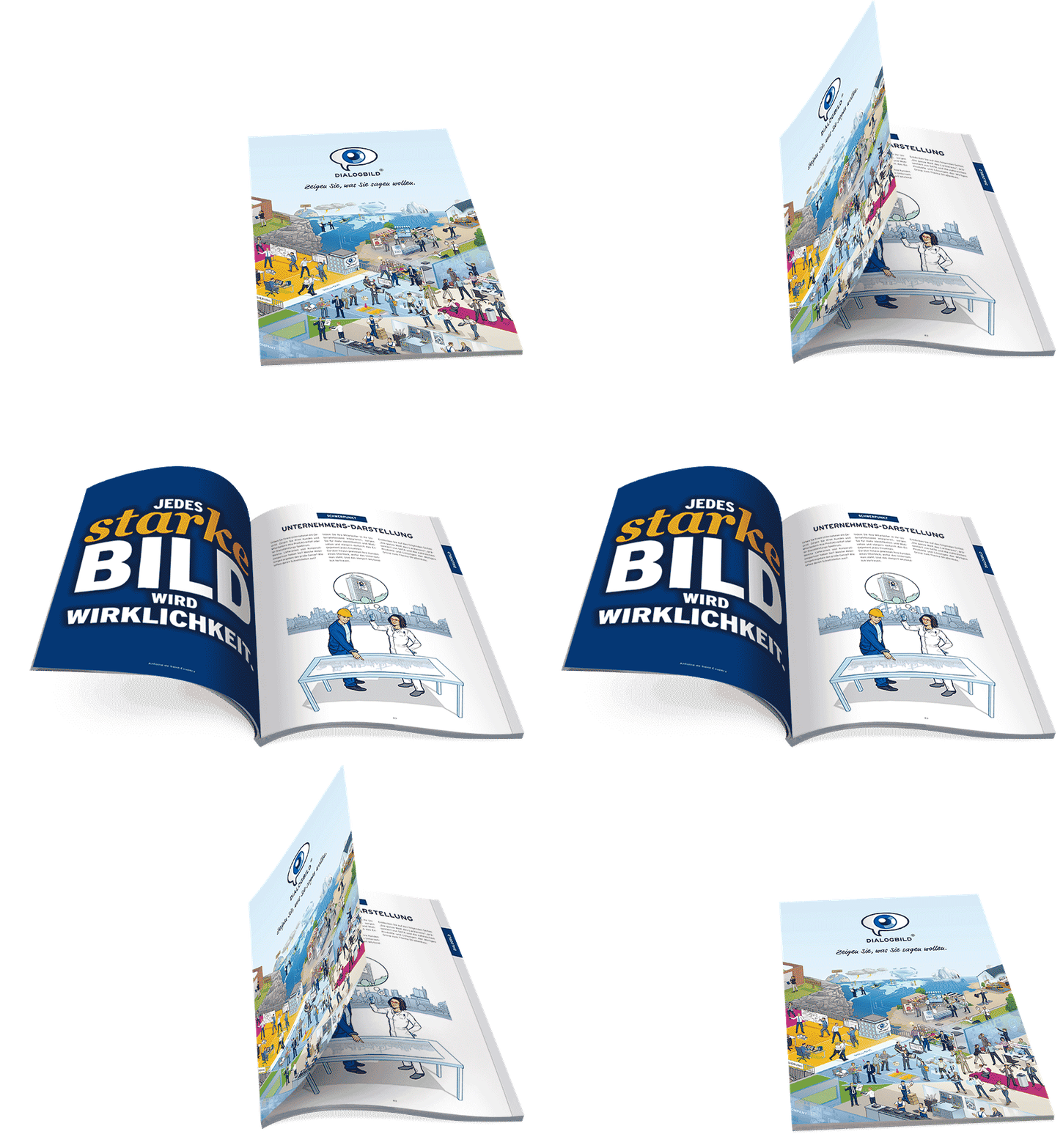
Dialog pictures offer a powerful alternative for conveying your change management strategy in a visually and emotionally engaging way. A dialog picture is a large-format, detailed visualisation that depicts a complex situation or process in a single, easily understandable scene.

This is how the DIALOGBILD agency supports you:

  1. Visualising complex processes: We translate your change processes into a clear, visual narrative. Instead of pages and pages of PowerPoint slides, you receive a visual map that illustrates the entire transformation from start to finish.
  2. Creating a shared vision: A ‘Dialogbild’ helps to create a shared vision for organisational development. Everyone involved looks at the same image, understands the interconnections and sees their place in the overall process. This is particularly effective in breaking down resistance to change, as it reduces uncertainty and creates transparency.
  3. Promoting dialogue and participation: The name says it all: dialog pictures encourage discussion. They serve as an interactive tool in workshops and meetings, where staff can discuss the content presented, ask questions and actively contribute to the process.
  4. Enhancing retention: Images stick in the memory. Complex information is processed more effectively and remembered for longer through visual representation. This ensures that your change management strategies are not forgotten, but remain deeply embedded in the corporate culture.

Why visual communication is more effective

Studies show that our brains process images significantly faster than text. Whilst you are reading a sentence, your brain has already taken in an image and understood the emotion behind it. This insight makes dialog pictures an extremely effective tool in change management:

  • Greater clarity: Visual representations simplify complex issues and make them understandable to all staff, regardless of their role or background.
  • Stronger emotional connection: A well-designed image can evoke emotions and create a positive association with the change, which promotes acceptance.
  • Lasting impact: Visual language appeals directly to people’s creative side and ensures that the core messages remain firmly in their memory.

Therefore, do not rely solely on text and figures; instead, incorporate visual tools such as dialog pictures to make your change processes more human, more understandable and, ultimately, more successful.

Conclusion: Change management as the key to business success

Change management is not a passing fad, but an essential skill for any modern organisation. It is the art of shaping change in such a way that it is supported by staff and delivers lasting success. By understanding the fundamentals of change management, applying tried-and-tested strategies and putting the human factor at the centre, you can master even the most significant change processes.

Would you like to delve deeper into the subject and gain access to specific tools for your next change project? Download our free e-book to discover further valuable strategies and practical checklists for change management.

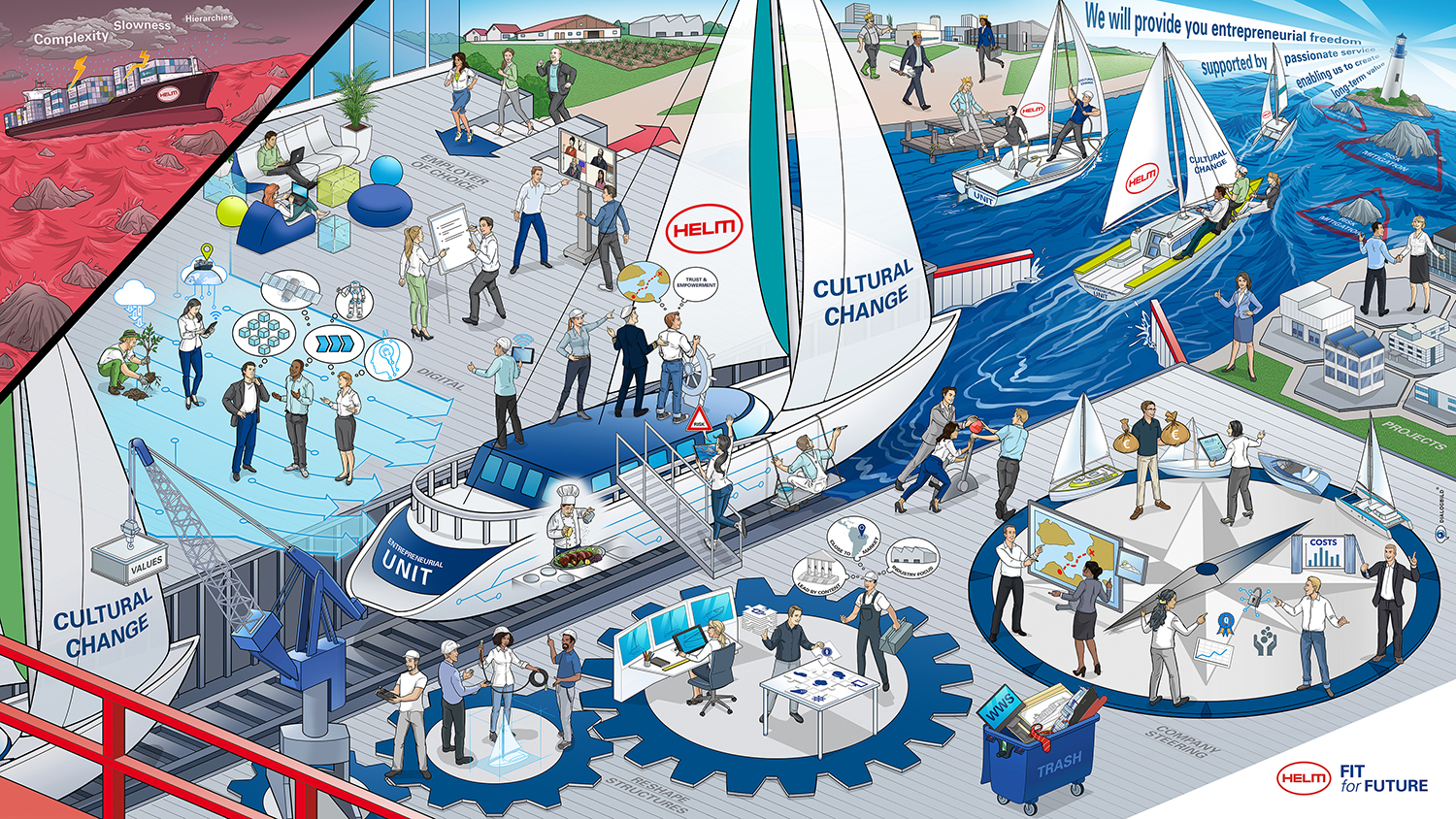
HELM AG Transformationsprozess Fit for Future Cultural Change Leitbild Chemicals Ferilizer Coop Protection Pharma Dialogbild Agentur für Visualisierung von Prozessen, Veränderungen und Visionen.

FIT FOR FUTURE


Helm is a globally active family-owned company headquartered in Hamburg, Germany. The fields of activity are the business units Chemicals, Fertilizer, Coop Protection and Pharma, which our company with its 1,500 employees takes care of.

In the course of the transformation process, we decided to use a dialog picture in order to communicate the different aspects and areas to our employees in an understandable and easy-to-remember way. For this purpose, each employee also received his or her own picture after the company meeting.


VW Nutzfahrzeuge Volkswagen Nutzfahrzeuge Transformation Werk Hannover Leitbild Strategiebild Dialogbild Agentur für Visualisierung von Prozessen, Veränderungen und Visionen.

TRANSFORMATION PLANT HANOVER


Process optimization, strategy, cultural work and good communication are key to the VW Nutzfahrzeuge plant management Hanover in leading the way to a successful future. In the past, strategy and transformation processes were often accompanied by powerpoint "battles".There were numerous charts that tried to make it as comprehensible as possible what goals the company wanted to achieve and how it planed to get there.

Now the company wants to go other ways and has developed a vision for the future together with Goldpark and DIALOGBILD. On the one hand, the picture emerged in an intensive process, on the other hand, the discussion about the things that are important to the board in the picture led to a common understanding and also made it possible for different perspectives to be discussed and brought together.

This helps the Hannover plant to communicate its way into the the future with a common voice.

Thanks to the close cooperation between Goldpark and DIALOGBILD, the dialog picture was used for all events, informations and formats that relate to the transformation as well as to reflect the developments in the transformation process.

Kärcher Changestory E2E supply Chain Excellence Leitbild Visionsbild Dialogbild Agentur für Visualisierung von Prozessen, Veränderungen und Visionen.

Logo von Kärcher

E2E Supply Chain Excellence

Alfred Kärcher SE & Co. KG is a family-owned company headquartered in Winnenden, Baden-Württemberg. The world market leader for cleaning technology employs more than 13,500 people worldwide. The company is particularly renowned for its high-pressure cleaners.

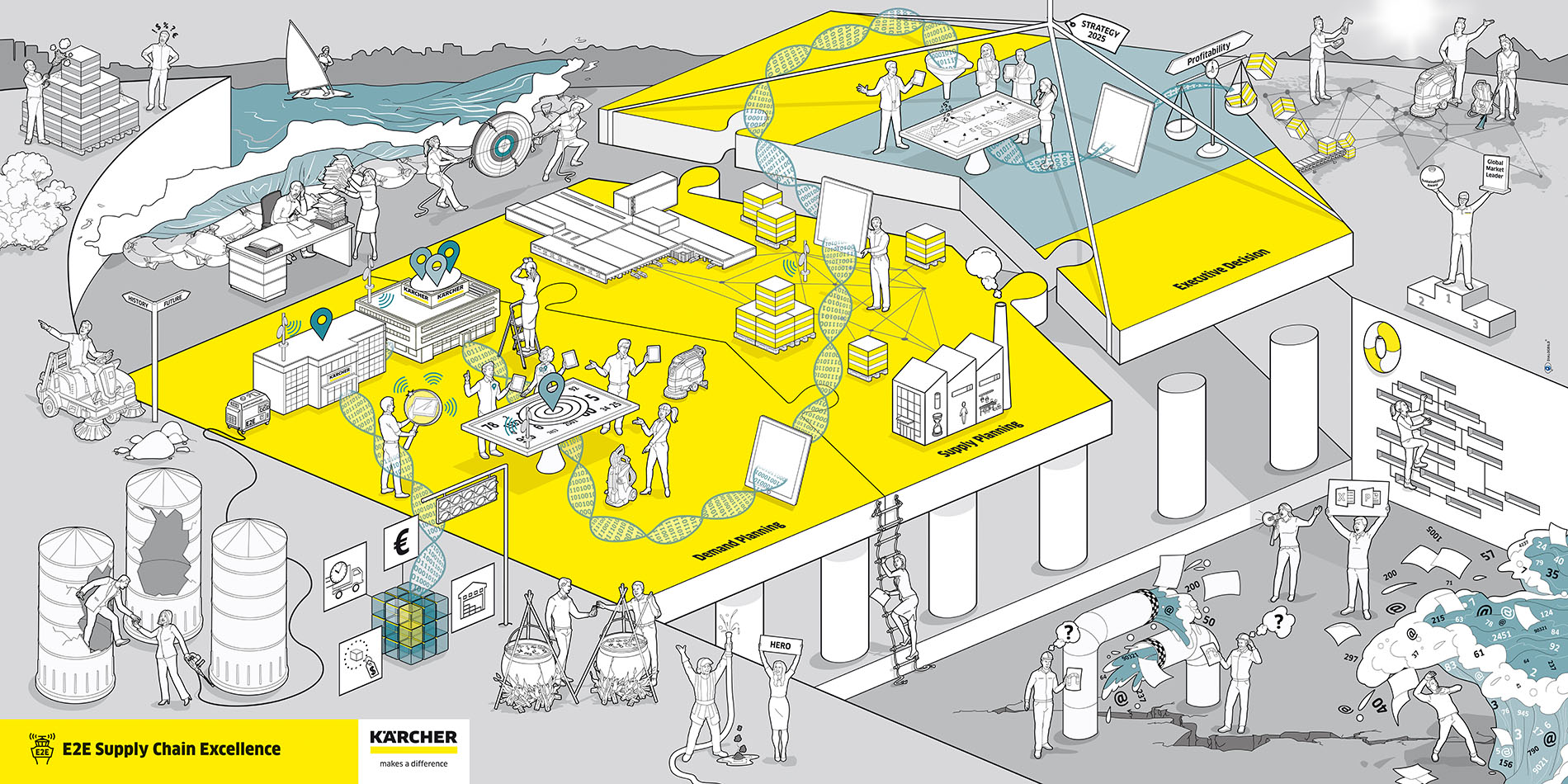
In order to remain the world market leader in the future and to be able to supply customers optimally, Kärcher is constantly working on the optimization of its own supply chain management. The current strategy-relevant “End-to-End Supply Chain Excellence” project involves changes in processes, roles and responsibilities that will affect around 6,000 employees worldwide. In order to guarantee a uniform understanding of all project participants, Kärcher developed the dialog picture of the “E2E Supply Chain Excellence” change project, which was developed by DIALOGBILD accordingly.

The picture visualizes the process of the project as a path, starting from the current Kärcher reality. The viewer is informed about the new supply chain process to be implemented, in which he follows a bridge that leads to the future of Kärcher.

The organisational changes enshrined in it are related and linked by a DNA strand that symbolizes the flow of all relevant data. The business management parameters: requirements, stocks, production volume and location are effectively aligned with one another in the projected target state and are available to the customer efficiently as a Kärcher product "all time, in full". The bridge is supported by a stable Master Data Management foundation and other strategically oriented Kärcher projects. Challenges, fears and concerns are successfully overcome.

A special feature of the development of this dialog picture was that the in-house Kärcher illustration style was adopted. For this purpose, the illustrations were adapted to Kärcher's corporate identity guidelines, from style to colour to line thickness.

AOK Gemeinsam auf KulTOUR Leitbild Visionsbild Dialogbild Agentur für Visualisierung von Prozessen, Veränderungen und Visionen.

OUR CULTOUR CHANGE


AOK Rheinland-Pfalz/Saarland - The health insurance company is the largest health insurance company in the two federal states of Rhineland-Palatinate and Saarland, with over 1. 2 million insured persons and 85,000 supervised employers as well as around 3,500 employees. The health insurance fund maintains business relationships with more than 100 hospitals, 10,000 doctors, psychotherapists and dentists, around 1,300 pharmacies and many hundreds of other contract partners. It offers high-quality care for the population and tailor-made concepts in the regions. For this, modern, future-oriented structures are also essential in the corporate culture.

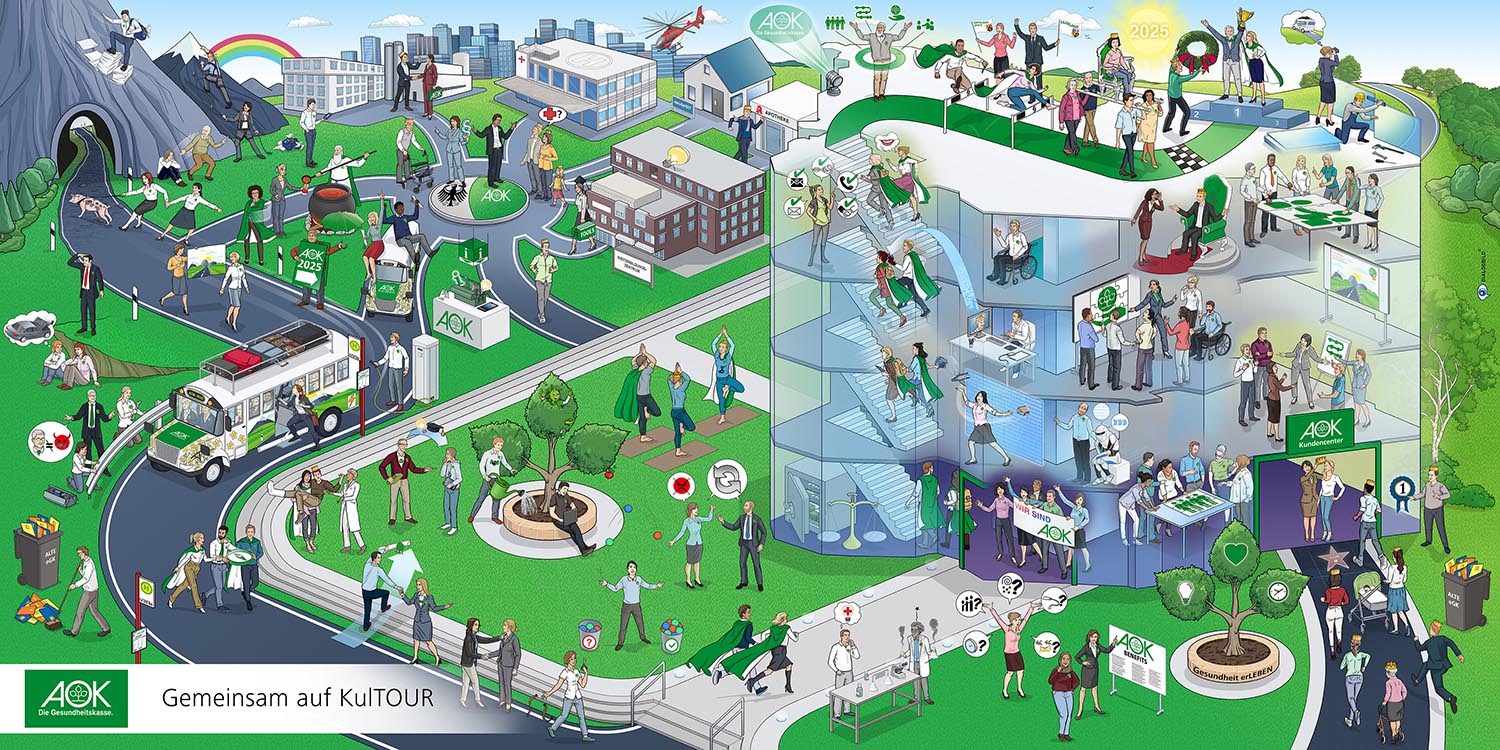
In the framework of the"Together on CulTOUR" programme, develops a vision of the future and principles for leadership and cooperation. The existing brand mission statement of the AOK-community was adapted.

The aim of the dialog picture is to communicate the developed products, to permanently anchor them and thus to create a successive "KulTOURwandel" which will prepare the AOK Rheinland-Pfalz/Saarland for the future challenges of the health and nursing insurance market.

With the help of the dialog picture, the complex contents have been depicted and brought into an overall context. This ensures a common understanding of the new. A further advantage is that all employees deal with the topics not only on the rational, but also on the emotional level, and the dialog picture provides space for constructive discussions and a valuable exchange of experiences or opinions.

Frequently Asked Questions (FAQ) on Change Management

Similar questions often arise during change processes. We have compiled and answered the most common ones for you to help you get your bearings quickly.

1. Why is change management so important?

Answer: In today’s fast-paced business world, constant adaptation is necessary to remain competitive. Change Management is crucial to ensure that these adaptations are not left to chance, but are managed in a targeted manner. It helps to minimise resistance to change, promote employee acceptance and ensure that the change is sustainably embedded in the organisation’s development. Without a structured approach, change processes risk failing, which can lead to staff dissatisfaction, falling productivity and high costs.

2. What are the biggest challenges in change management?

Answer: The biggest challenge is often the human factor. Resistance to change is a natural reaction. A lack of communication, a lack of trust in leadership and uncertainty about one’s own responsibilities are common reasons for this. Other challenges may include an unclear vision, insufficient resources or a lack of support from top management.

3. How do I overcome resistance to change?

Answer: Resistance is best overcome through proactive and empathetic change management strategies. Focus on:

  • Transparent communication: Explain the ‘why’ behind the change.
  • Early involvement: Involve staff in the process as early as possible.
  • Empathy: Take concerns and fears seriously.
  • Training and support: Provide staff with the necessary skills and assistance.
  • Visible successes: Celebrate small, quickly visible successes to keep motivation high.

4. What role do managers play in the change process?

Answer: Managers play an absolutely crucial role. They are the most important advocates and role models. Their responsibilities include:

  • Communicating the vision and urgency of the change in a convincing manner.
  • Actively leading by example and supporting the change.
  • Being available as a point of contact for their teams and building trust.
  • Empowering staff to participate in the change.

5. How do I measure the success of change management?

Answer: Success can be measured using various Key Performance Indicators (KPIs). These include:

  • Quantitative KPIs: adherence to the project schedule and budget, productivity metrics, error rates.
  • Qualitative KPIs: staff satisfaction (e.g. through surveys), reduction in complaints, acceptance of the new processes and tools. It is important that you define these criteria right at the start of the change process and review them regularly.

6. Can the Dialogbild agency help with my change process?

Answer: Yes, absolutely. As specialists in visual communication, we help you to present complex change processes in a way that is both understandable and engaging. Using a dialog picture, we translate your change management strategies into memorable images that stimulate dialogue, allay uncertainties and create a shared vision. This increases acceptance and ensures that your change management is successful not only on paper, but also in the minds of your staff.