The Comprehensive Guide to Organisational Development

Markets are changing at breakneck speed, new technologies emerge monthly, and the demands of both employees and customers are constantly evolving. In this dynamic environment, you, as a manager, HR professional, or consultant, face a crucial challenge: How do you keep your organization adaptable, competitive, and human-centered? The answer lies in organizational development.

Sustainable organizational development is not a one-off project completed in a few weeks. It is a long-term, holistic transformation process that evolves structures, processes, and human behavior patterns equally. Future-proofing your organization requires a deep understanding of systems, methods, and corporate cultures.

This comprehensive guide leads you step-by-step through the theoretical foundations, proven methods, practical applications, and success factors of modern organizational development. You will learn how to effectively manage change processes, engage your workforce through visual communication tools, and shape your company for the future.

1. What is Organizational Development?

To successfully initiate change within a company, a clear understanding of what holds the system together internally is essential. Organizational development provides the strategic and methodological framework for this.

Definition of Organizational Development

Organizational development is understood as a planned, systemic, and long-term process of change. The goal is to increase the organization's performance (efficiency and adaptability) while simultaneously improving the quality of work and the development opportunities for employees.

Unlike short-term restructuring, organizational development pursues a holistic approach:

  • Systemic: It views the company as a complex ecosystem in which technology, structure, strategy, and culture are closely intertwined.
  • Participatory: Change is not simply imposed top-down but is shaped with the active involvement of the employees affected.
  • Process-oriented: The path is just as crucial as the destination. Behavioral patterns and attitudes change through continuous learning.

Objectives of Organizational Development

When you launch organizational development initiatives, you typically pursue a set of interdependent objectives. These can be divided into economic and humanitarian goals:

  • Increasing agility and flexibility: Your organization learns to react more quickly and effectively to external market changes.
  • Optimizing collaboration and processes: Silos between departments are broken down, interfaces are smoothed, and decision-making processes are shortened.
  • Promoting innovation: An open learning culture creates space for new ideas and creative solutions.
  • Increasing motivation and engagement: Employee involvement strengthens identification with company goals and reduces turnover.

Importance of organizational culture

Your organizational culture forms the foundation of every development measure. You can redraw processes and rearrange organizational charts - if the underlying values, norms and unwritten laws do not follow suit, any change will come to a standstill.

The organizational culture determines how employees communicate with each other, how errors are dealt with and how much responsibility managers give up. Successful organizational development is therefore always based on cultural behavior patterns and makes invisible barriers open to discussion.

2. Methods of organizational development

In order for change to be successful, you need the right tools. Selecting the right organizational development methods has a decisive influence on how well those involved are integrated and goals are achieved.

Top 5 methods of organizational development

1. Visual dialog picture (DIALOG PICTURE method): Complex strategies, target states and transformation paths are translated into a tailor-made visual map. In moderated workshops, this dialog picture serves as a common basis for discussion at all hierarchical levels in order to create a uniform understanding.

2. Appreciative Inquiry: This approach does not focus on deficits, but rather on the organization's existing strengths, previous successes and potential. The future will be shaped from this positive basis.

3. Survey Feedback: Data-supported method in which current states are collected through employee surveys. The results are discussed directly in the teams in order to jointly derive concrete measures.

4. World Café & Open Space: Large group formats that make it possible to engage in a structured, creative exchange with dozens or hundreds of employees at the same time and to identify areas of action.

5. Agile retrospectives: Regular reflection meetings in which teams examine in short cycles what went well, what hindered and what specific improvements will be implemented in the next step.

Comparison between traditional and agile methods

Traditional organizational development approaches often follow a sequential pattern (Plan-Build-Run). However, agile organizational development is gaining increasing importance in dynamic markets.

Attribute Traditional organizational development Agile organizational development
Procedure Long-term, cascading, phase-based Iterative, in short sprints, experimental
Planning Detailed multi-year plans Adaptive Roadmapping Approach
Focus Stability, standardization, control Flexibility, customer value, rapid learning effects
Role of leadership Prescribe, control, monitor Empowering, removing obstacles, coaching
Role of employee Executing, questioning at specific points Actively participating, self-organized

Case Studies of Successful Implementations

  • Case Study: Mechanical Engineering (Traditional Medium-Sized Company): A leading industry consultant supported a medium-sized company in realigning its sales and service processes. Using DIALOGBILD's DIALOG PICTURE method, the complex new target vision was anchored in a single visual overview. For the first time, the workforce understood the interrelationships between departments, which reduced the implementation time by 30%.
  • Case Study: IT Service Provider (Scaling): A rapidly growing tech company used agile organizational development to break down rigid departmental structures into cross-functional teams. Through bi-weekly retrospectives and visual Kanban boards, the lead time of customer projects was halved.

3. Change Management and Its Role

In practice, the terms change management and organizational development are often conflated or used synonymously. To precisely manage your transformation projects, it is worthwhile to take a closer look at the interplay between these two disciplines.

What is Change Management?

While organizational development provides the long-term, holistic framework for a system's learning and growth, change management focuses on the concrete management and support of a specific change (e.g., the introduction of a new ERP system or a merger). Change management provides methods to guide affected individuals purposefully from a defined current state (AS-IS) to a desired state (TO-BE) (TO-BE).

Change Management Models

Various phase models have become established for structuring change:

  • John P. Kotter's 8-Step Model: From generating a sense of fear or urgency, through formulating a clear vision and removing obstacles, to anchoring the new approaches in the culture.
  • Kurt Lewin's 3-Step Model: Unfreeze (thawing the status quo), Change (transitioning to new behaviors), Refreeze (stabilizing the new state).
  • ADKAR model (Prosci): Focuses on the individual along the steps of Awareness, Desire, Knowledge, Ability and Reinforcement.

Success Factors in Change Management

The success of change initiatives depends heavily on the quality of communication. Consider the following key factors for your practice:

  • Clarity before detail: Communicate the "why" behind the change before burdening employees with complex details.
  • Visual anchoring: Use clear visualizations instead of purely textual concepts. When managers and employees share the same visual vision of the target landscape, the risk of misunderstandings decreases dramatically.
  • Empathy and dialogue: Resistance is a natural human reaction to uncertainty. Acknowledge anxieties and engage in genuine dialogue on equal footing.

4. Team development in the context of organizational development

An organization can only develop as quickly as the teams that comprise it. Team development is therefore a crucial building block for effectively anchoring organizational goals at the operational level.

Team Development Methods

To develop a team from a group of individualists into a high-performing unit, proven organizational development methods are available:

  • Utilize the Tuckman Model: Understand that every team must go through the Forming (orientation), Storming (close-quarters combat), Norming (organization), and Performing (performance) phases.
  • Role Definition and Alignment: Clarify expectations, interfaces, and responsibilities transparently.
  • Team Canvas & Visual Workshops: Use visual templates on which the team collaboratively develops and displays its vision, values, rules, and goals.

Case Studies of Successful Team Development

In an international logistics company, siloed thinking between the IT and operations teams led to constant delays. As part of a team development initiative, DIALOGBILD developed a customized dialog picture that humorously and accurately illustrated the interfaces and typical areas of conflict in daily operations.

In jointly facilitated workshops, the teams used the image as a neutral platform to address problems directly without attacking individuals. The result: Cross-departmental communication improved sustainably, and interface problems were reduced by 45%.

Challenges and Solutions in Team Development

  • Challenge: Hidden conflicts and lack of trust.

    • Solution: Create psychological safety. Leaders should openly address their own mistakes to pave the way for honest feedback.

  • Challenge: Conflicting goals between different departments.

    • Solution: Develop an overarching goal landscape that illustrates how the individual contributions of different teams contribute to the overall result.

5. The Importance of Organizational Culture

Sustainable organizational development is inconceivable without consciously shaping the organizational culture. It determines whether changes remain vibrant in daily operations or quickly fade away.

Definition of Organizational Culture

Organizational culture is the ensemble of shared values, beliefs, traditions, and behaviors within your company. It shapes the phenomenon: "This is how we do things here." While strategy and structure form the "skeleton" of an organization, culture corresponds to its "nervous system" and "soul."

Influence on Employee Satisfaction

A strong, healthy organizational culture has a direct, positive influence on employee satisfaction and performance:

  • Purpose: Employees who understand how their work contributes to the overall picture demonstrate greater engagement.
  • Trust & Autonomy: Cultures that prioritize trust over control foster initiative and innovation.
  • Appreciation: A strong culture of recognition strengthens employee loyalty and reduces turnover costs.

Successfully Implementing Cultural Change

Cultural change cannot be mandated – it must be exemplified and experienced. Use these steps for implementation:

1. Analyze the current cultural state: What unwritten rules are hindering progress?

2. Define and visualize the target culture: What does the desired behavior look like in concrete terms? Use visual language to make values ​​tangible.

3. Management's role as a role model: Leaders must be the first to embody the new values.

4. Adapt structures: Incentive systems, promotion criteria, and feedback processes must align with the new target culture.

6. Summary and outlook

Organizational development is the answer to the increasing complexity of our modern working world. It combines strategy, structure, and people into an adaptable overall system.

Key aspects of organizational development:

  • Holistic approach: Organizational development encompasses structure, process, team, and organizational culture.
  • Participation: Successful change arises from the involvement of employees, not from directives.
  • Methodological Diversity: Utilize proven organizational development methods, agile approaches, and visual communication tools to reduce complexity.
  • Leadership: Modern leaders act as coaches and enablers of change.

Future Trends in Organizational Development

  • AI-Supported Organizational Development: Use people analytics and AI tools to identify change needs early and evaluate surveys in real time.
  • Hybrid & Remote Culture: Develop organizational cultures that foster cohesion and trust even in distributed, location-independent teams.
  • Continuous Learning: Shift from isolated transformation projects to a "learning organization" that continuously adapts.

Recommendations for Your Practice

1. Start with transparency: Communicate the reason for the change openly and honestly.

2. Use the power of visualization: Make complex strategies and visions tangible for every employee.

3. Celebrate small successes (quick wins): This reduces skepticism and generates momentum for the journey ahead.

Start your organization's transformation!

Are you facing the challenge of future-proofing your strategy, structures, or corporate culture? Do you want to inspire your employees from the very beginning and bring them along on this journey?

At DIALOGBILD, we translate complex change processes into clear, customized visual communication tools. We create clarity, break down silos, and initiate genuine dialogue at all hierarchical levels.

Contact us today and schedule a free initial consultation with our experts in visual organizational development.

Contact DIALOGBILD now to schedule a consultation.


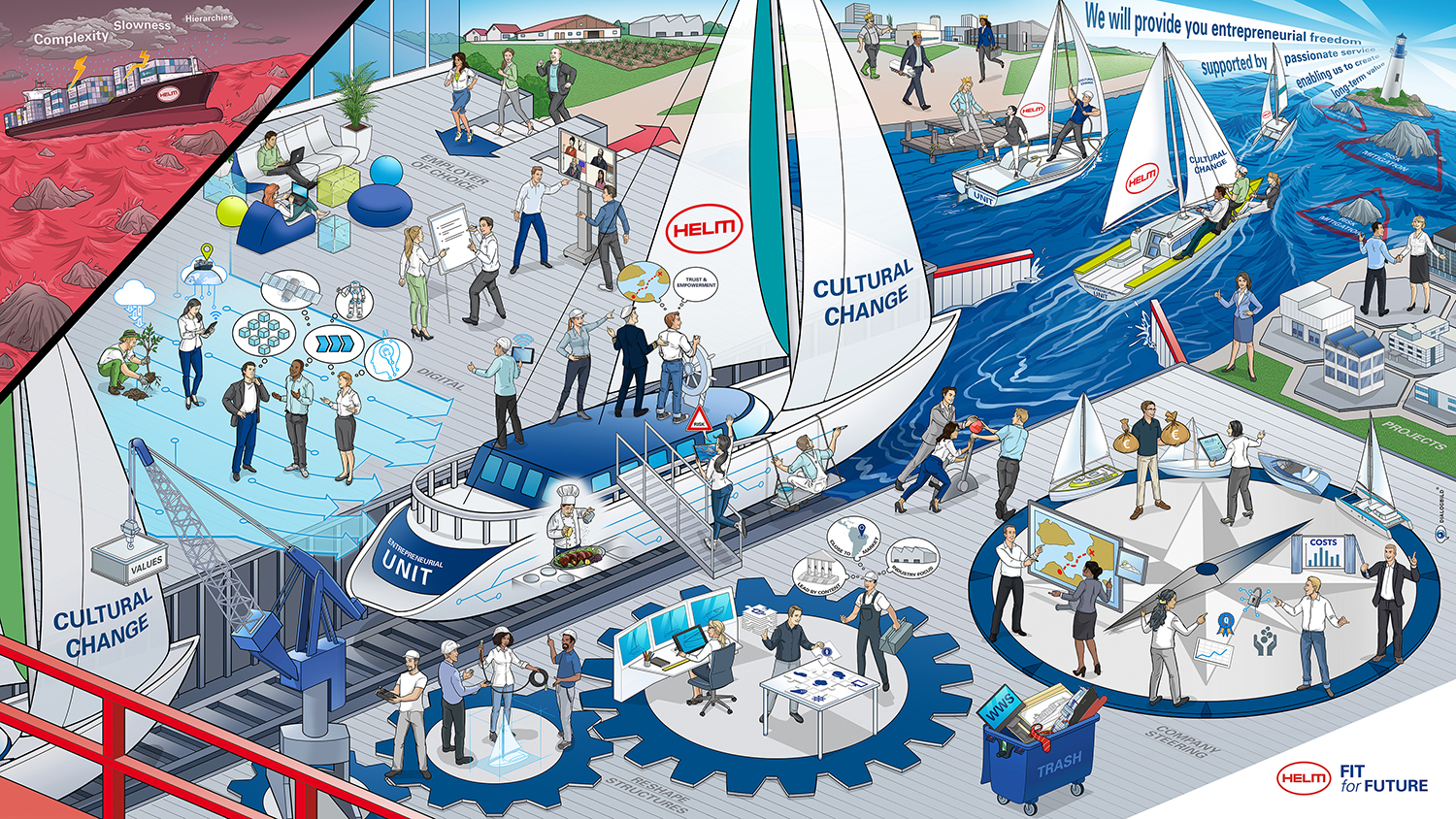
HELM AG Transformationsprozess Fit for Future Cultural Change Leitbild Chemicals Ferilizer Coop Protection Pharma Dialogbild Agentur für Visualisierung von Prozessen, Veränderungen und Visionen.

FIT FOR FUTURE


Helm is a globally active family-owned company headquartered in Hamburg, Germany. The fields of activity are the business units Chemicals, Fertilizer, Coop Protection and Pharma, which our company with its 1,500 employees takes care of.

In the course of the transformation process, we decided to use a dialog picture in order to communicate the different aspects and areas to our employees in an understandable and easy-to-remember way. For this purpose, each employee also received his or her own picture after the company meeting.
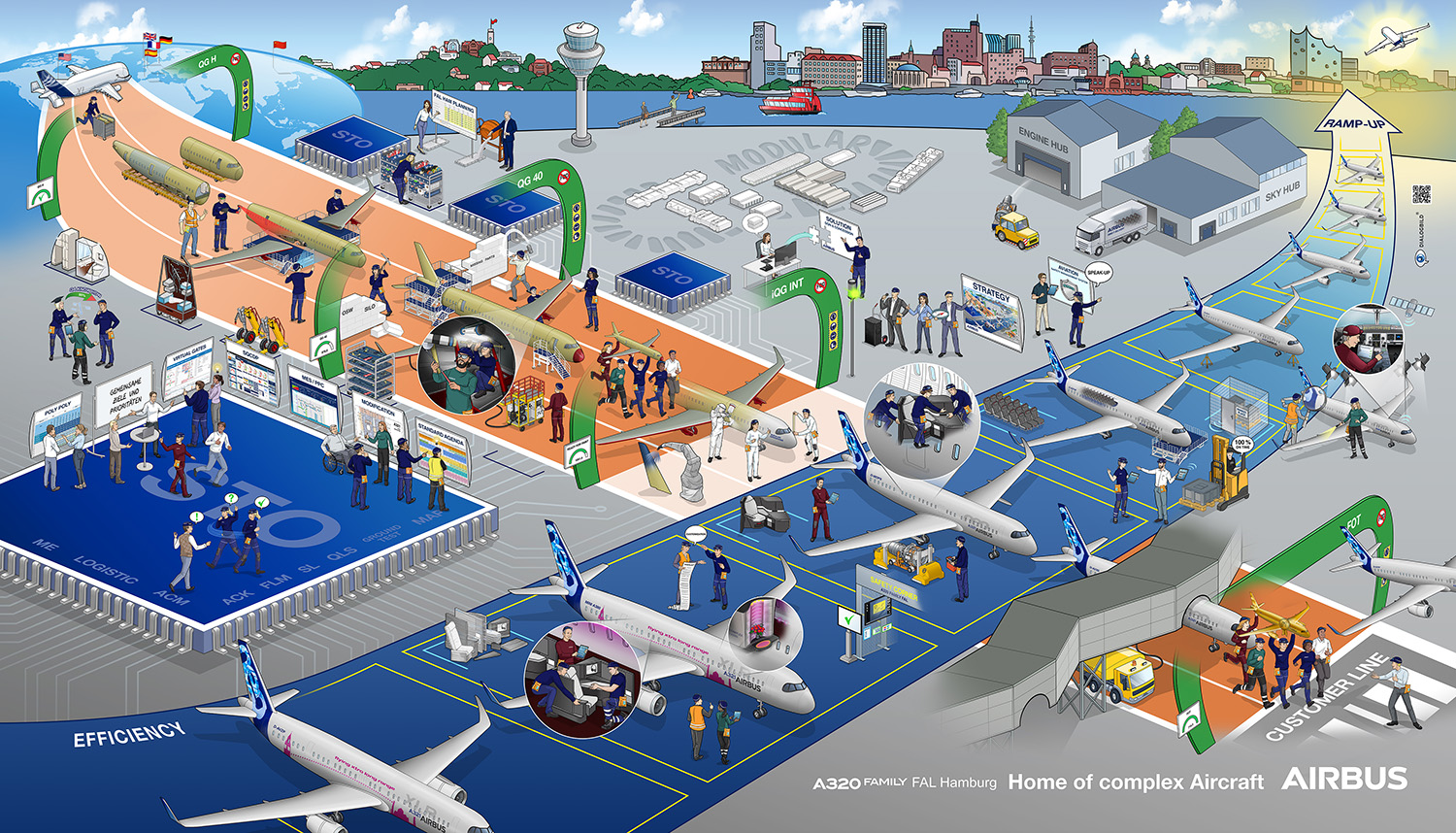

A DIALOG PICTURE FOR AIRBUS AND THEIR NEW MODULAR CONCEPT


The Airbus plant in Hamburg-Finkenwerder is the largest Airbus site in Germany. Among other things, this is where the final assembly of the well-known A320 family takes place. As part of an internal restructuring, sequential line production is being converted to a mixed production organization, with the first half of production taking place in a synchronized area and the second half at a modular station. This means that various activities per aircraft that currently take place at several stations will be carried out at a single station.

The new modular concept is to be made visually understandable to production employees with the aid of a dialog picture, and the advantages and opportunities for all those involved are to be highlighted.

During a comprehensive tour of the factory, the DIALOGBLD team had everything shown to them in detail and took photos so that the individual machines and production steps could be depicted as authentically as possible in the final dialog picture.

The finished dialog picture will be displayed prominently in the production halls for everyone to see and will be used for internal workshops. ...

VW Nutzfahrzeuge Volkswagen Nutzfahrzeuge Transformation Werk Hannover Leitbild Strategiebild Dialogbild Agentur für Visualisierung von Prozessen, Veränderungen und Visionen.

TRANSFORMATION PLANT HANOVER


Process optimization, strategy, cultural work and good communication are key to the VW Nutzfahrzeuge plant management Hanover in leading the way to a successful future. In the past, strategy and transformation processes were often accompanied by powerpoint "battles".There were numerous charts that tried to make it as comprehensible as possible what goals the company wanted to achieve and how it planed to get there.

Now the company wants to go other ways and has developed a vision for the future together with Goldpark and DIALOGBILD. On the one hand, the picture emerged in an intensive process, on the other hand, the discussion about the things that are important to the board in the picture led to a common understanding and also made it possible for different perspectives to be discussed and brought together.

This helps the Hannover plant to communicate its way into the the future with a common voice.

Thanks to the close cooperation between Goldpark and DIALOGBILD, the dialog picture was used for all events, informations and formats that relate to the transformation as well as to reflect the developments in the transformation process.
Kärcher Changestory E2E supply Chain Excellence Leitbild Visionsbild Dialogbild Agentur für Visualisierung von Prozessen, Veränderungen und Visionen.

Logo von Kärcher

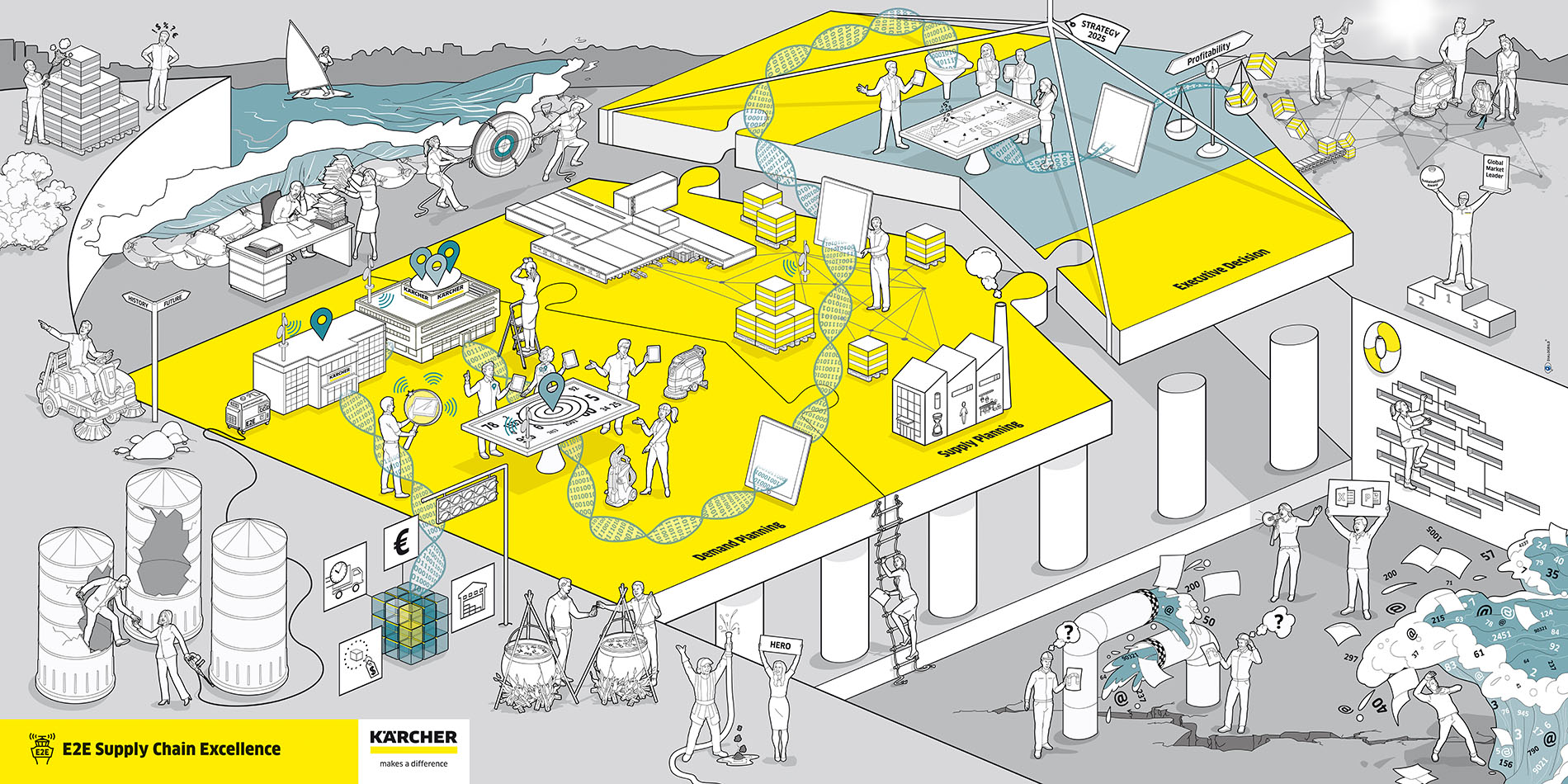
E2E Supply Chain Excellence

Alfred Kärcher SE & Co. KG is a family-owned company headquartered in Winnenden, Baden-Württemberg. The world market leader for cleaning technology employs more than 13,500 people worldwide. The company is particularly renowned for its high-pressure cleaners.

In order to remain the world market leader in the future and to be able to supply customers optimally, Kärcher is constantly working on the optimization of its own supply chain management. The current strategy-relevant “End-to-End Supply Chain Excellence” project involves changes in processes, roles and responsibilities that will affect around 6,000 employees worldwide. In order to guarantee a uniform understanding of all project participants, Kärcher developed the dialog picture of the “E2E Supply Chain Excellence” change project, which was developed by DIALOGBILD accordingly.

The picture visualizes the process of the project as a path, starting from the current Kärcher reality. The viewer is informed about the new supply chain process to be implemented, in which he follows a bridge that leads to the future of Kärcher.

The organisational changes enshrined in it are related and linked by a DNA strand that symbolizes the flow of all relevant data. The business management parameters: requirements, stocks, production volume and location are effectively aligned with one another in the projected target state and are available to the customer efficiently as a Kärcher product "all time, in full". The bridge is supported by a stable Master Data Management foundation and other strategically oriented Kärcher projects. Challenges, fears and concerns are successfully overcome.

A special feature of the development of this dialog picture was that the in-house Kärcher illustration style was adopted. For this purpose, the illustrations were adapted to Kärcher's corporate identity guidelines, from style to colour to line thickness.

AOK Gemeinsam auf KulTOUR Leitbild Visionsbild Dialogbild Agentur für Visualisierung von Prozessen, Veränderungen und Visionen.

OUR CULTOUR CHANGE


AOK Rheinland-Pfalz/Saarland - The health insurance company is the largest health insurance company in the two federal states of Rhineland-Palatinate and Saarland, with over 1. 2 million insured persons and 85,000 supervised employers as well as around 3,500 employees. The health insurance fund maintains business relationships with more than 100 hospitals, 10,000 doctors, psychotherapists and dentists, around 1,300 pharmacies and many hundreds of other contract partners. It offers high-quality care for the population and tailor-made concepts in the regions. For this, modern, future-oriented structures are also essential in the corporate culture.

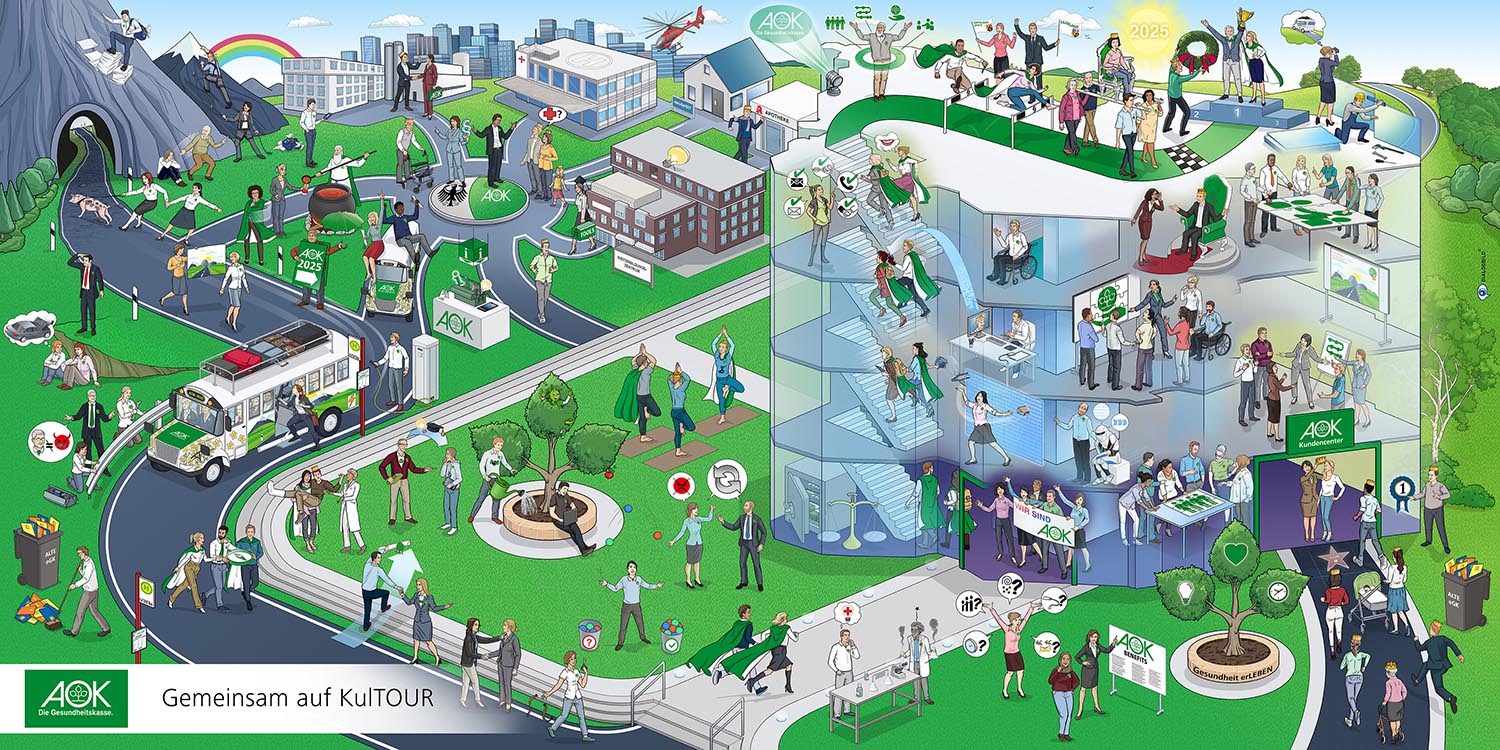
In the framework of the"Together on CulTOUR" programme, develops a vision of the future and principles for leadership and cooperation. The existing brand mission statement of the AOK-community was adapted.

The aim of the dialog picture is to communicate the developed products, to permanently anchor them and thus to create a successive "KulTOURwandel" which will prepare the AOK Rheinland-Pfalz/Saarland for the future challenges of the health and nursing insurance market.

With the help of the dialog picture, the complex contents have been depicted and brought into an overall context. This ensures a common understanding of the new. A further advantage is that all employees deal with the topics not only on the rational, but also on the emotional level, and the dialog picture provides space for constructive discussions and a valuable exchange of experiences or opinions.
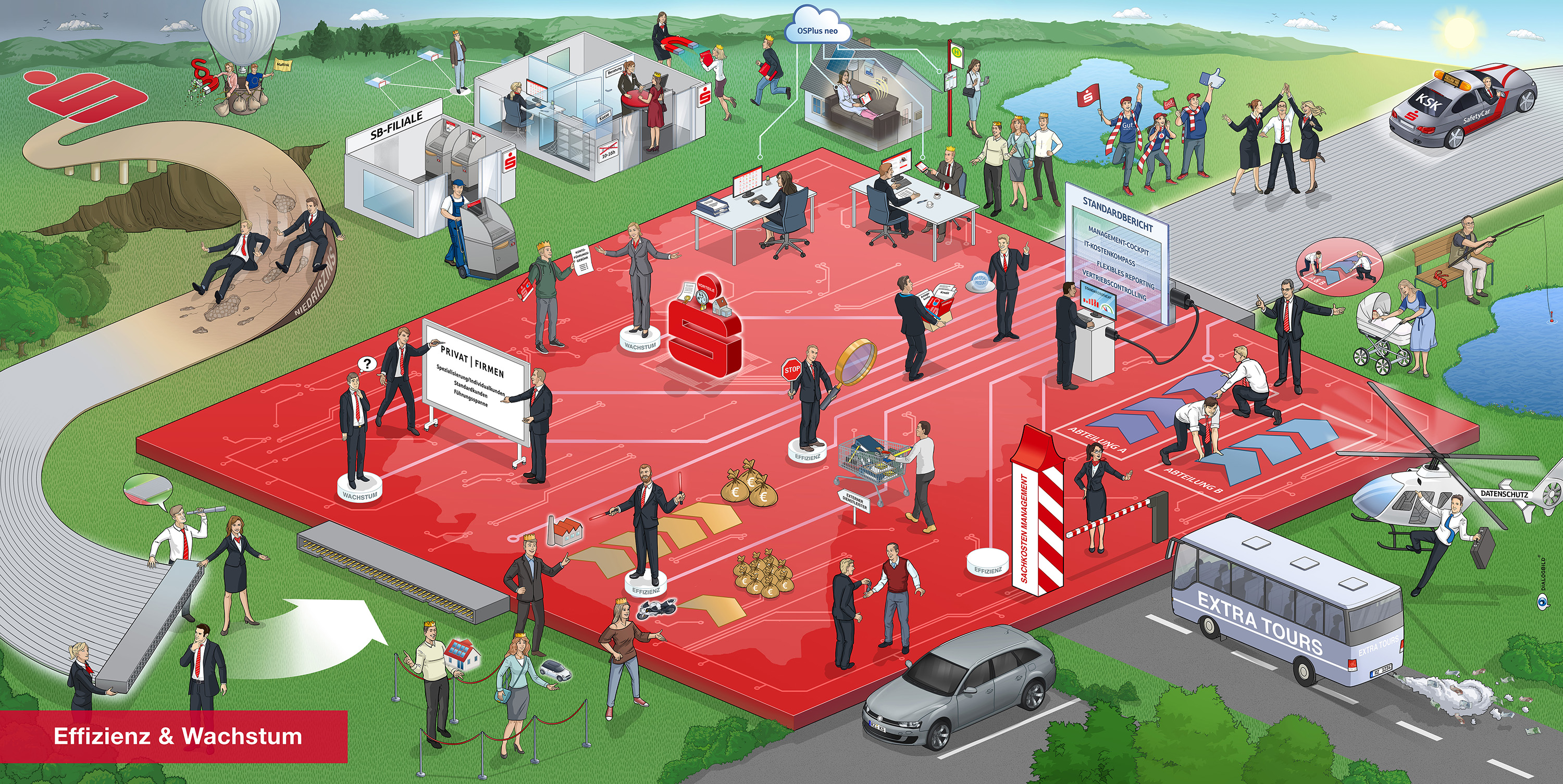

Kreissparkasse Herzogtum Lauenburg Digitalisierung Strategiebild Visionsbild Leitbild Dialogbild Agentur für Visualisierung von Prozessen, Veränderungen und Visionen.

EFFICIENCY & GROWTH


The Kreissparkasse Herzogtum Lauenburg considers it important to take responsibility for the common good. As a strong partner, it acts on behalf of its customers, the economy and the region. The Kreissparkasse provides its customers with a comprehensive advisory service based on the Sparkassen financial concept, which is tailored to individual customer needs. Through its advisory services, the Kreissparkasse aims to enable customers to make their own financial decisions and supports them in choosing the right products to suit their personal life plans. Based on its guiding principle of thrift, the Kreissparkasse is also committed to resource-efficient and sustainable business practices. The stability of its economic structure, climate protection, the adaptation of social systems to demographic challenges and the review of lifestyles in view of dwindling resources are important areas of activity for Kreissparkasse Herzogtum Lauenburg.

Frequently Asked Questions (FAQ) on Organizational Development

What distinguishes organizational development from traditional restructuring?

Traditional restructuring is usually short-term, financially driven, and purely top-down: organizational charts are redrawn and personnel structures are adjusted. Organizational development, on the other hand, is a long-term, holistic learning process. It actively involves the workforce, develops not only processes but also the organizational culture, and focuses on the sustainable future viability of the entire system.

How long does a comprehensive organizational development process take?

Since it involves a profound transformation of thought and behavior patterns, strategic development phases typically extend over 12 to 36 months. However, initial tangible quick wins and improved cross-departmental communication can often be achieved after just a few weeks—provided you prioritize transparency and participatory workshop formats.

Why are DIALOGBILD's visual dialogue media so effective in change processes?

Complex concepts, new strategies, and abstract corporate values ​​often lead to misunderstandings or overwhelm when presented in text form. A customized visual map from DIALOGBILD translates this complexity into an understandable, visual language. It serves as a neutral basis for discussion in workshops at all hierarchical levels, breaks down language barriers, and encourages genuine dialogue.

How can skeptical employees and managers be successfully engaged?

Resistance usually arises from uncertainty or a lack of information. The best way to address this is to transform those affected into active participants:

  • Demonstrate the urgency and purpose: Communicate transparently why the change is necessary.
  • Create safe spaces: Provide space for fears and concerns in moderated dialogue formats.
  • Use visual anchors: Work with dialogue images to make target states tangible and to discuss reservations constructively.

What is meant by Agile Organizational Development?

In contrast to traditional, rigid multi-year plans, Agile Organizational Development relies on an iterative approach. Changes are tested in short adaptation cycles (sprints), continuously reflected upon through feedback, and flexibly adjusted as needed. This significantly increases your organization's adaptability in dynamic markets.

How can the success of development measures be measured concretely?

Success is reflected in the interplay of qualitative and quantitative indicators:

  • Qualitative: Increased satisfaction scores in employee surveys, improved trust index, and a visible shift in the feedback culture.
  • Quantitative: Decreased employee turnover and absenteeism rates, higher application numbers (stronger employer brand), and shorter project and decision-making cycles.

Ready for the next step in your organizational development?

Would you like to make your strategy, change initiatives, or target culture immediately understandable and tangible for all employees?

The DIALOGBILD team of experts supports you in translating your transformation processes into compelling visual media and establishing effective dialogue workshops within your company.

Contact DIALOGBILD now and schedule your personal consultation!