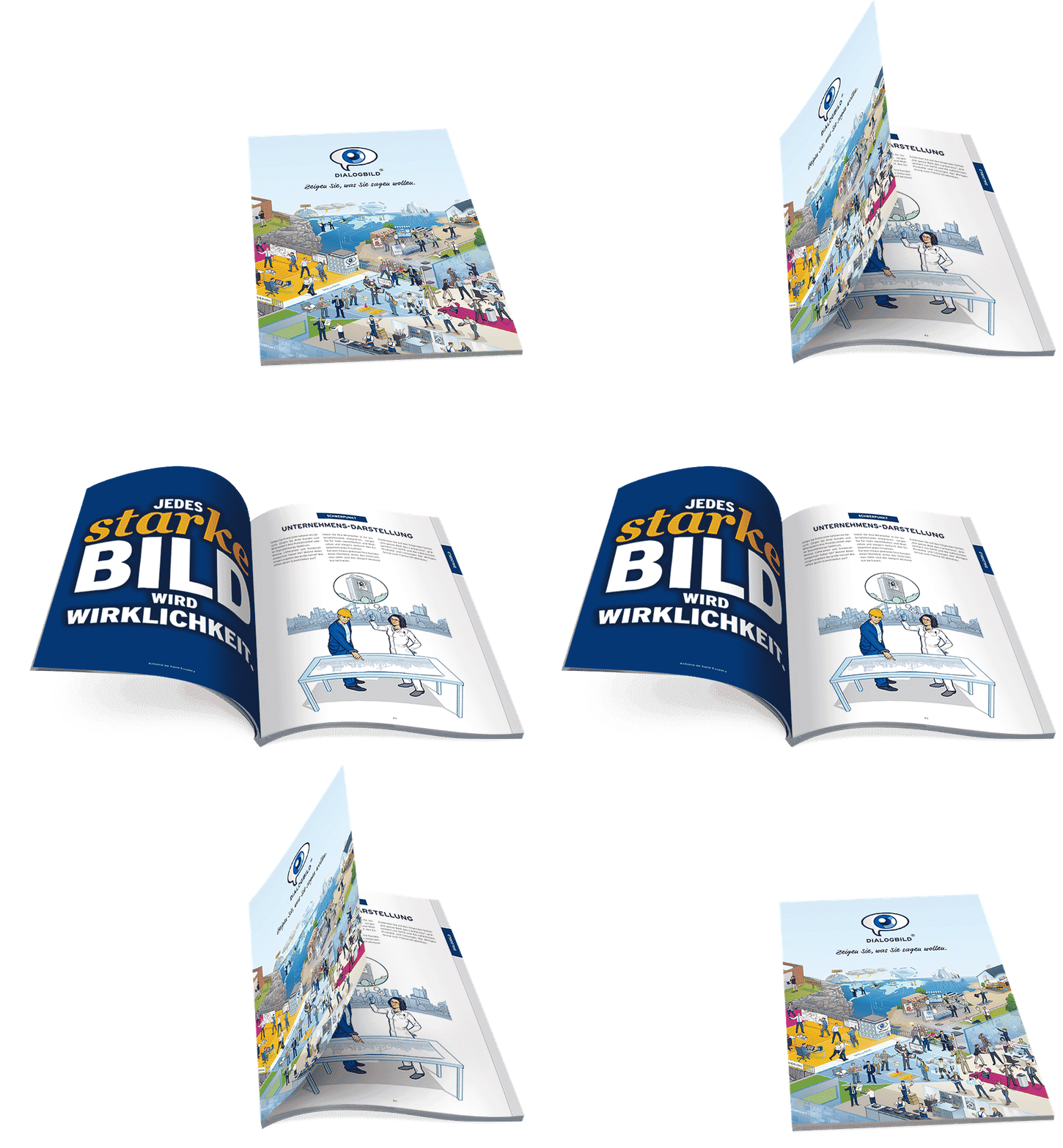
Method Deep Dive: How to Facilitate a Vision Workshop for Your Leadership Team
An effective vision board is never the product of a single individual, but rather the distillation of a collaborative process. To create a robust vision board that garners acceptance across all hierarchical levels, a methodologically sound strategy workshop is the surest path. Here, diverse perspectives from sales, marketing, and production converge within a moderated framework to coalesce into a unified identity.
The Phases of Collaborative Visual Development
Developing a guiding vision begins not with drawing, but with listening. The primary objective of the initial workshop phase is to decipher the abstract goals set by senior management. Only once a consensus has been reached regarding key performance indicators (KPIs) and the desired corporate philosophy does work on the visual dimension commence. In this process, the vision board serves as a catalyst: it compels participants to translate vague concepts—such as "customer proximity" or "innovative strength"—into concrete images and scenes.
Why Facilitation Makes the Difference
All too often, rigid structures in meetings prevent genuine breakthroughs. Our experts in visual strategy facilitation employ specialized visualization techniques to resolve these blockages. When teams collaborate to create a vision board, it fosters a powerful sense of shared identity—a "we-feeling"—that extends far beyond the day of the workshop itself. Participants transform from passive subjects into active architects of their own future. The vision board thus becomes tangible proof of the direction established together, reinforcing leadership capabilities at every level.
From Sketch to Professional Dialog Picture
Following the creative phase of the workshop, our illustrators produce a professional final rendering. Based on the initial sketches and metaphors, they craft a high-caliber strategic vision that perfectly reflects your corporate identity. This final vision board is then strategically integrated into your internal communications. Whether displayed as a large-format print in the foyer or utilized as an interactive tool on the intranet, the result is a visualized strategy that sustains high levels of employee motivation over the long term and strengthens identification with the company.
OUR WAY. OUR FUTURE.
THE FUTURE PICTURE FOR TÜV RHEINLAND
The TÜV Rheinland Group is a leading provider of technical services worldwide. Founded in 1872 and headquartered in Cologne, the Group employs 20,000 people, 8,000 of them are based in Germany. It generates annual revenues of € 1.88 billion. The Group′s mission and guiding principle is to achieve sustained development of safety and quality in order to meet the challenges arising from the interaction between man, technology and the environment.
TÜV Rheinland started a comprehensive change program which addressed a new strategy, projects to improve internal processes and changes of the company culture and leadership culture.
In order to ensure that everyone has the same understanding of the future basic principles, strategy and values of the company, TÜV Rheinland decided to create a dialog picture. The objective was to stimulate the exchange of the most important topics, which TÜV Rheinland will be dealing with in the upcoming years. The creation of the dialog picture was a very complex project which was accompanied by the team of DIALOGBILD over several months.
STRATEGY 2030
With the EPEUM® culture program and the Strategy 2030 project - Our path to a successful tomorrow - Sparkasse Oberhessen has consistently set out on the path toward securing the future of its savings bank. The transformation towards a new, transparent and positively lived corporate culture is in full swing. Its future project "Strategy 2030" is essentially about developing an idea - a vision - today of what the savings bank could look like in a decade's time in order to continue to be successful. In the five identified topic areas of "Private Customers," "Corporate Customers," "Operations & Processes," "Human Resources," and "Steering," the respective interdisciplinary and cross-hierarchically structured project teams have started work and demonstrated: We have considerable potential for improvement - in our organization, in our processes, in sales and in increasing our earnings.
FIT FOR FUTURE
Helm is a globally active family-owned company headquartered in Hamburg, Germany. The fields of activity are the business units Chemicals, Fertilizer, Coop Protection and Pharma, which our company with its 1,500 employees takes care of.
In the course of the transformation process, we decided to use a dialog picture in order to communicate the different aspects and areas to our employees in an understandable and easy-to-remember way. For this purpose, each employee also received his or her own picture after the company meeting.
Get info package