The ultimate guide to the supply chain in Germany

In a constantly evolving global economy, it is crucial for companies not only to understand their own processes but also to continuously improve them. A key concept that is gaining increasing importance in this context is the value chain. It is the backbone of every business model and significantly determines efficiency, competitiveness, and success. But how exactly does a value chain work, and, more importantly, how can you optimize it to maximize value creation in your industry? In this comprehensive guide, we walk you through the essential steps – from fundamental value chain analysis to the latest trends and best practices. Take the first step toward revolutionizing your company's value creation processes.

1. What is a Value Chain?

Definition of the Value Chain

The value chain, a concept popularized by Michael E. Porter, describes all the activities a company undertakes to produce and sell a product or service to a customer. Each of these activities contributes to the creation of value, ideally exceeding the costs of those activities. The chain begins with the procurement of raw materials and ends with after-sales service. The goal is to create added value at each stage that justifies the price of the final product and thus increases the company's profit margin.

History and Development

The value chain concept was introduced in the 1980s by Michael E. Porter in his book "Competitive Advantage." Porter argued that a company's competitive advantage depends not only on the industry but also on how its internal activities are structured and executed. Since then, the concept has evolved and is now an indispensable tool for value chain management in companies worldwide. It is no longer just a theoretical model, but the basis for strategic decision-making.

Importance in Today's Economy

In today's globally interconnected world, the value chain is more complex and dynamic than ever before. It is crucial for:

  • Competitive advantage: Companies that manage their value creation processes better than their competitors can reduce costs or increase the quality of their products.
  • Efficiency: Analyzing the chain reveals inefficiencies and bottlenecks, which can lead to significant cost savings.
  • Transparency: It helps to trace the origin of raw materials and the conditions of production – an important factor for modern value creation in industry with a focus on sustainability.

2. The Components of a Value Chain

A Porter value chain consists of primary and support activities. Each activity is a piece of the puzzle that contributes to the overall value creation.

Primary Activities

Primary activities are directly involved in the production and distribution of a product. They include:

  • Inbound logistics: Receiving, storing, and distributing raw materials and components.
  • Production: Transforming raw materials into the finished product.
  • Outbound logistics: Storing and distributing the finished product to the customer.
  • Marketing and sales: Promoting the product and closing sales.
  • After-sales service: Providing customer support after the purchase (e.g., repairs, maintenance).

Support Activities

Supporting activities are necessary to enable primary activities. These include:

  • Business infrastructure: management, planning, finance, and quality management.
  • Human resources: recruitment, training, and development of employees.
  • Technology development: research, development, and implementation of new technologies.
  • Procurement: purchasing raw materials, supplies, and other resources.

Interaction between components

True added value arises from the seamless interaction of these components. Efficient inbound logistics directly impacts production costs, while excellent customer service increases brand loyalty. Therefore, a successful value chain analysis views the chain not as isolated steps, but as an interconnected system in which each activity influences the others.

3. Value Chain Analysis

Value chain analysis is the first and most important step toward optimization. It helps you understand where and how value is created or lost.

Analysis Methods

  • Process Mapping: Visualize each step of the value creation process from beginning to end. This helps identify bottlenecks and inefficient steps.
  • Benchmarking: Compare your own processes with those of industry leaders to identify best practices and learn from them.
  • Cost-Benefit Analysis: Evaluate the costs and benefits of each activity to determine which steps deliver the greatest added value and which may be inefficient.

Tools and Technologies

Modern technology offers powerful tools for value chain analysis:

  • ERP (Enterprise Resource Planning) systems: Provide a central platform for capturing and analyzing all company data.
  • Business intelligence software: Visualizes data and makes it easy to understand.
  • Process mining tools: Automatically analyze log data to reconstruct the actual value chain process and identify weaknesses.

Examples of successful analyses

An automotive manufacturer might use value chain analysis to determine that a specific assembly step requires more time and resources than planned. By analyzing the process and comparing it with other plants, they can address the root cause and increase efficiency.

4. Value Chain Optimization

After value chain analysis comes optimization. This is the process of addressing identified weaknesses and increasing efficiency.

Value Chain Optimization Strategies

  • Cost Reduction: Identify unnecessary expenses in procurement, production, or logistics.
  • Quality Improvement: Increase product quality to boost customer satisfaction and minimize returns.
  • Differentiation: Create unique value for the customer that the competition cannot offer (e.g., faster shipping, better customer service).
  • Outsourcing: Transfer non-value-adding or costly activities to external service providers to focus on your core competencies.
  • Value Chain Visualization: Complexity and lack of clarity are often the biggest obstacles to optimization. The agency DIALOGBILD can support you here by creating interactive visualizations. Such a "dialog picture" makes each step of the value chain and the interactions of the individual components understandable at a glance. It serves as an effective communication and analysis tool to clearly illustrate the processes to all involved and to jointly discover optimization potential.

Industry Best Practices

Companies like Amazon continuously optimize their value chain by relying on an extremely efficient logistics network and predicting customer preferences through data analysis. Tesla integrates vertically by manufacturing many components in-house to maintain control over quality and the speed of innovation.

Technological Innovations

Modern technologies are revolutionizing value creation in industry:

  • Automation and robotics: Accelerate production and reduce errors.
     
  • Artificial intelligence (AI): Optimizes demand forecasts and inventory levels.
     
  • Blockchain: Increases product transparency and traceability.
     
  • Industry 4.0: Connects machines and processes to create a "smart factory."

5. Current Trends in the Value Chain

The future of the value chain is shaped by new trends that companies must consider today.

Sustainability in Value Creation

Sustainability is no longer an optional luxury, but a crucial competitive factor. Companies are required to reduce their ecological footprint and assume social responsibility. A sustainable value chain is characterized by resource-efficient production, fair working conditions, and the use of renewable energies.

Digitalization and Automation

The ongoing digitalization is transforming the entire value creation process. From automated order processing to intelligent logistics, manual work steps are being reduced and efficiency increased. Value chain management is becoming increasingly precise through real-time data and predictive analytics.

Global Supply Chains and Challenges

Global value chains have become more vulnerable due to political uncertainties, pandemics, and trade conflicts. Resilience and diversification are therefore crucial. Companies must develop strategies to respond flexibly to disruptions and avoid dependence on individual suppliers or regions.

6. Case Studies: Successful Value Chains

Practical examples demonstrate how the concepts of value chain analysis and value chain management prove their worth in practice.

Successful Companies and Their Strategies

  • Apple: The company has perfected its value chain by strictly controlling design, marketing, and sales, while outsourcing production to specialized partners. This ensures quality and allows Apple to focus on its core competencies.
     
  • Zara (Inditex): The value creation in this fast-fashion retailer's industry is based on extremely short response times. Zara produces a large portion of its clothing in Europe to react quickly to fashion trends, rather than accepting long delivery times from Asia.

Key Lessons from the Case Studies

The examples of Apple and Zara show that there is no single right way. The crucial factor is developing a value chain that optimally aligns with one's own strategic goals. A successful strategy can consist of vertical integration (Tesla) as well as a focus on core competencies (Apple).

Adapting to Your Own Company

What can you learn from these case studies? Start with a thorough value chain analysis to identify the strengths and weaknesses of your own supply chain. Then consider which technologies and strategies are best suited to optimizing your value creation processes.

Conclusion: Increase Your Competitiveness Through Value Chain Optimization

The value chain is more than just a theoretical model—it's a crucial tool for your company's success. Consistent value chain analysis and optimization will help you reduce costs, increase quality, and secure a sustainable competitive advantage. Integrating new technologies and focusing on resilience are key to future success.

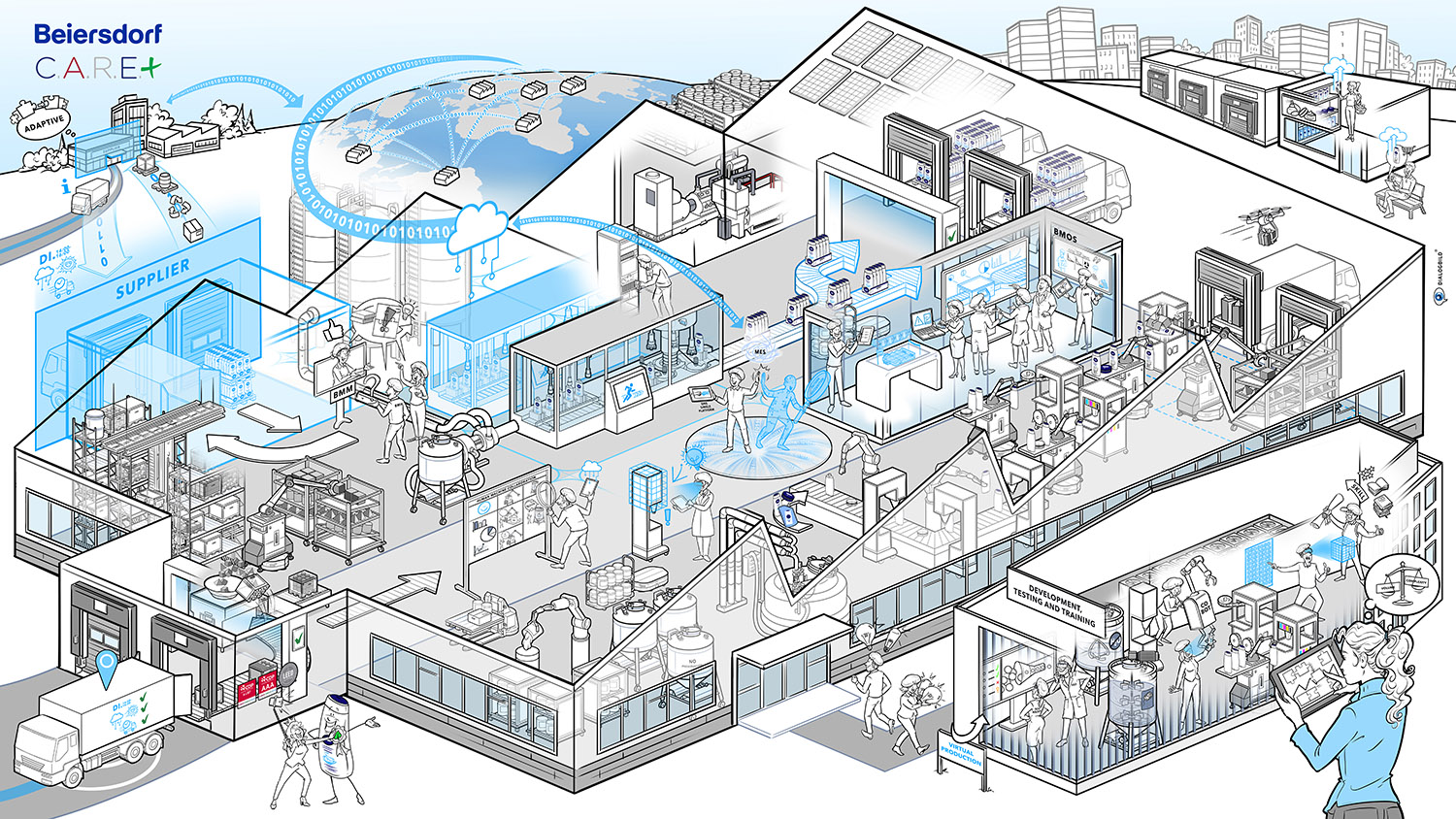
Beiersdorf Fabrik der Zukunft Leitbild Digital Supply Chain Visionsbild Dialogbild Agentur für Visualisierung von Prozessen, Veränderungen und Visionen.

Beiersdorf Fabrik der Zukunft Leitbild Digital Supply Chain Visionsbild Dialogbild Agentur für Visualisierung von Prozessen, Veränderungen und Visionen.

FACTORY OF THE FUTURE

Beiersdorf Digital Supply Chain Vision

For over 140 years the Beiersdorf AG has been standing for innovative, high-quality skin and body care, as well as leading skin research. The company convinces customers worldwide with its internationally leading brands and their consumer-needs oriented product portfolio. The supply chain, with its resilient and modern production network, significantly adds to this success.

The production processes find themselves in change during the fourth industrial revolution. They become more efficient and connected through the use of modern technologies, as well as artificial intelligence, the Internet of Things and automatization. The “Factory of the Future” relies on agility, sustainability, productivity and transparency, all of which is driven by digitalization. People and data play a central role in this. Our dialog picture shows exactly these important points and paints a picture of the future.
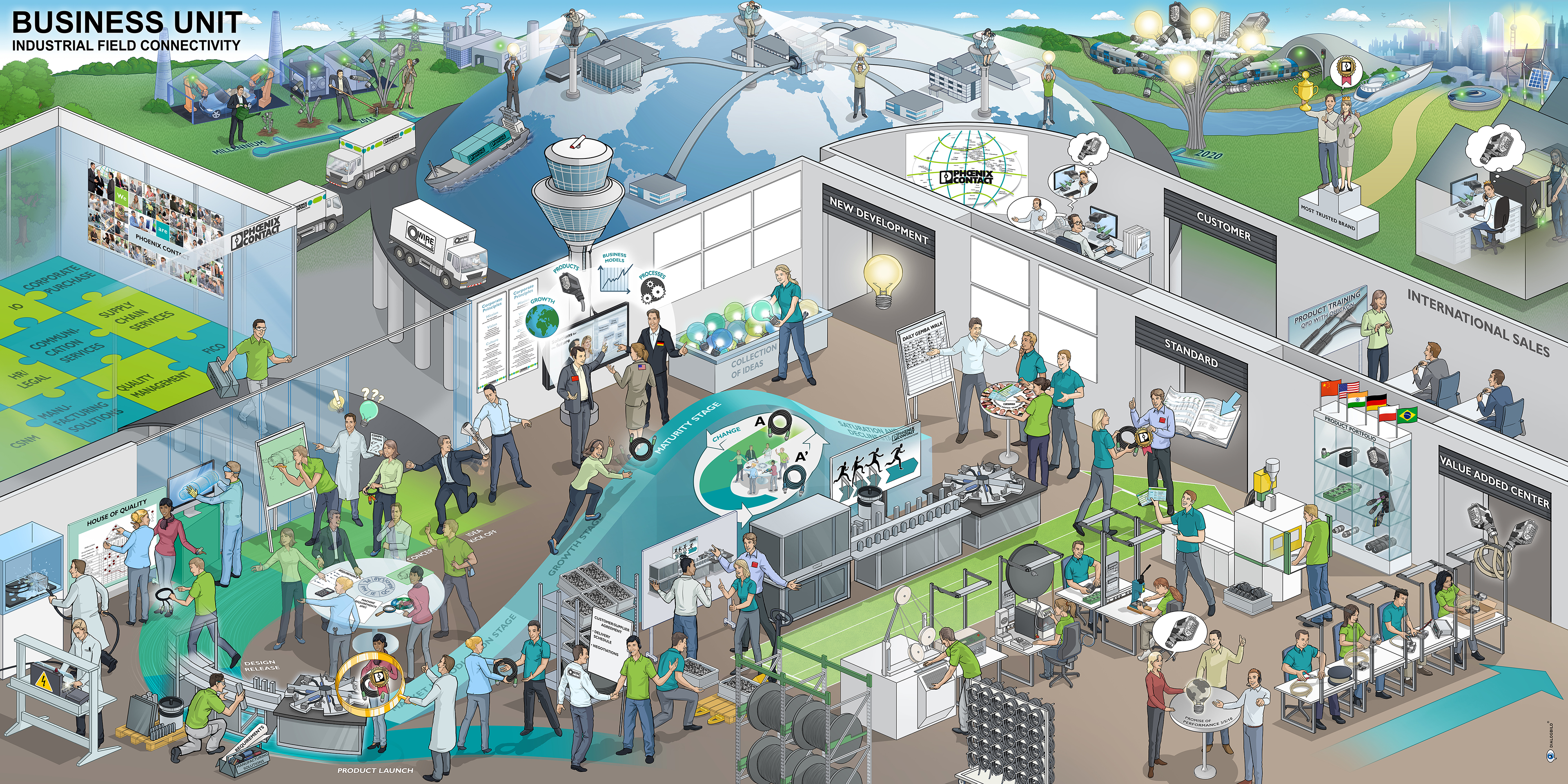

Phoenix Contact Business Unit Industrial field connectivity Leitbild Strategiebild Dialogbild Agentur für Visualisierung von Prozessen, Veränderungen und Visionen.

Logo von Phoenix Contact

WE GROW TOGETHER

INDUSTRIAL FIELD CONNECTIVITY

Phoenix Contact began as a family-owned business and has grown to become a global market leader in electronics. It seeks to improve itself continuously with the goal being speed and flexibility in reacting to customer needs and market developments. Therefore, Phoenix Contact has changed from a centralized organizational structure to a decentralized product oriented enterprise in order to bring a strong market and customer focus with regard to market segmentation. For one of the resulting business units, industrial field connectivity, DIALOGBILD created a strategy picture, which shows the interfaces, processes and stakeholders. The aim of this picture is a common understanding for a functioning network across all business units and the goals of this specific business unit IFC.

A strategy for growth needs the cooperation and acceptance of all staff. So, Phoenix Contact decided from the beginning, to allow everyone to participate in the development workshops. In the first workshop the managers created the background and structure. The second workshop was used to define the content by a cross-departmental group.
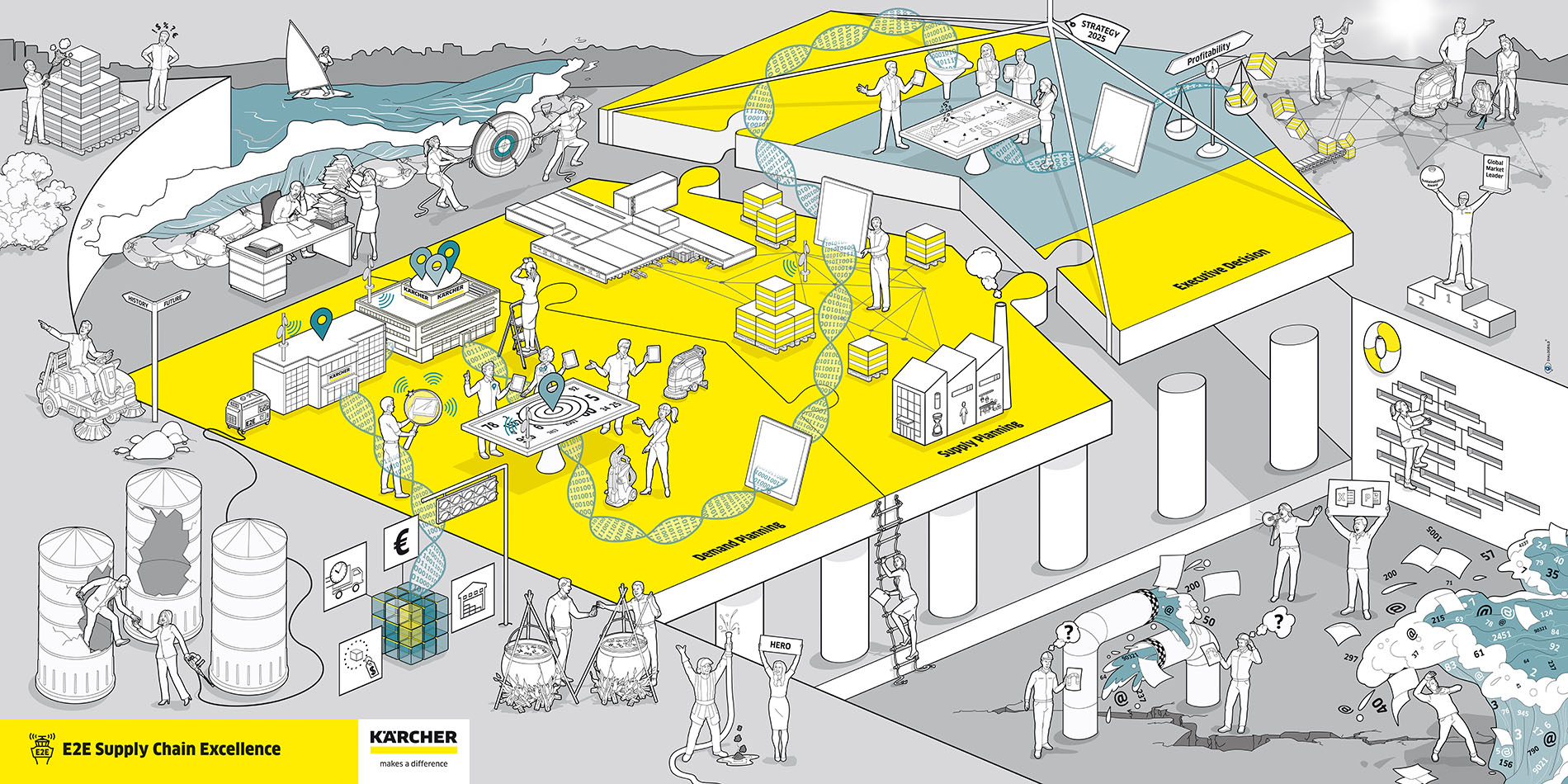

Kärcher Changestory E2E supply Chain Excellence Leitbild Visionsbild Dialogbild Agentur für Visualisierung von Prozessen, Veränderungen und Visionen.

Logo von Kärcher

E2E SUPPLY CHAIN EXCELLENCE

Alfred Kärcher SE & Co. KG is a family-owned company headquartered in Winnenden, Baden-Württemberg. The world market leader for cleaning technology employs more than 13,500 people worldwide. The company is particularly renowned for its high-pressure cleaners.

In order to remain the world market leader in the future and to be able to supply customers optimally, Kärcher is constantly working on the optimization of its own supply chain management. The current strategy-relevant “End-to-End Supply Chain Excellence” project involves changes in processes, roles and responsibilities that will affect around 6,000 employees worldwide. In order to guarantee a uniform understanding of all project participants, Kärcher developed the dialog picture of the “E2E Supply Chain Excellence” change project, which was developed by DIALOGBILD accordingly.
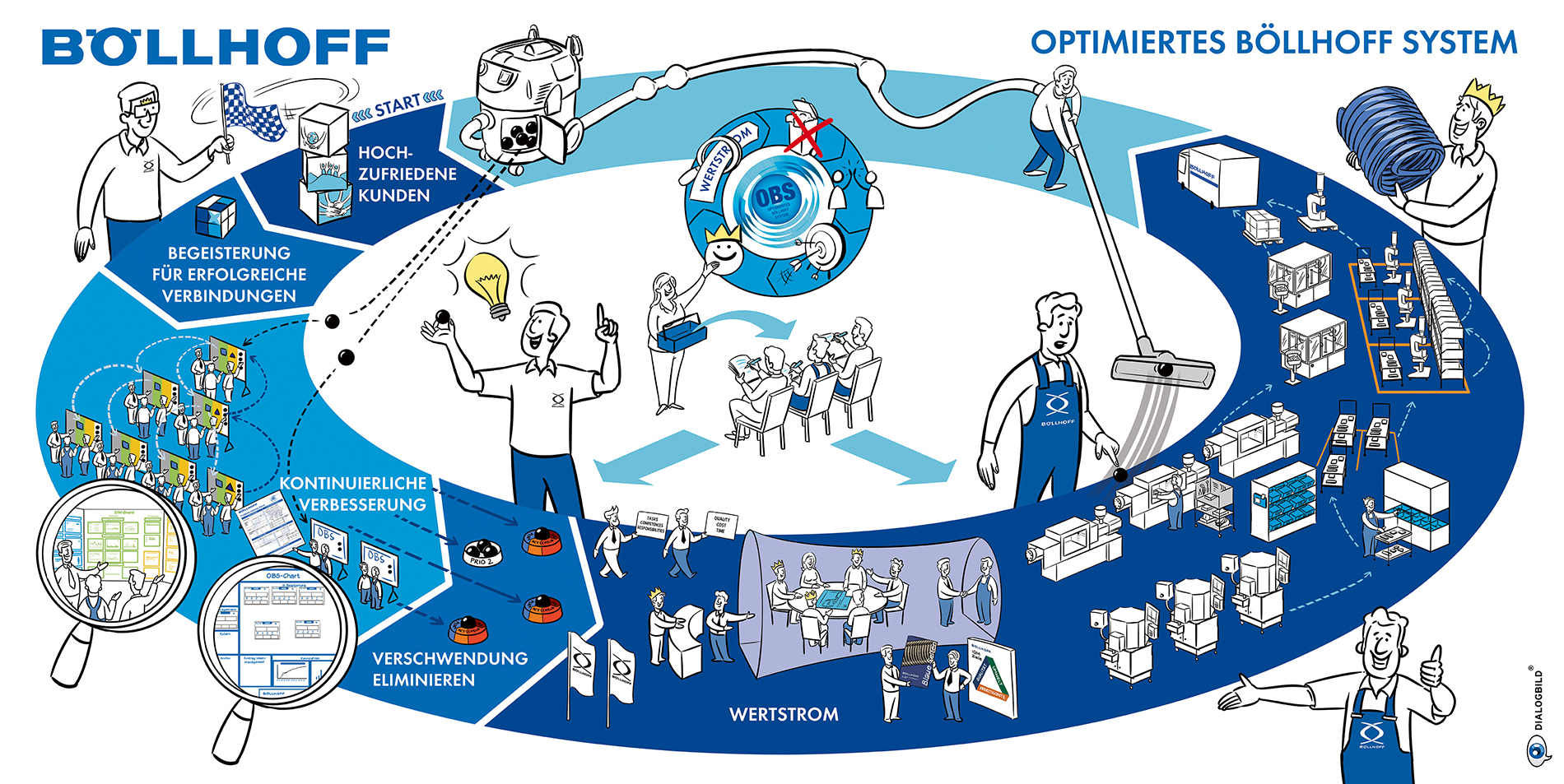

Böllhoff optimiertes Böllhoff System Leitbild Strategiebild Dialogbild Agentur für Visualisierung von Prozessen, Veränderungen und Visionen.

Logo von Böllhoff

OPTIMIZED BÖLLHOFF SYSTEM

Böllhoff is a family business in fourth generation. The company was founded in 1877. They are now one of the world′s leading manufacturers and suppliers of fasteners and processing systems. The long-term success is achieved by highly qualified employees, innovative products and customer-focused services. The core principles of the “Optimized Böllhoff System” (OBS) shall always be available for the employees of Böllhoff and shall influence their daily actions. In order to completely understand these principles, various methods and tools were developed which are used to train and qualify the employees of Böllhoff. The dialogue picture light visualises the relations between OBS core principles at a glance and enables transparency for the employees.
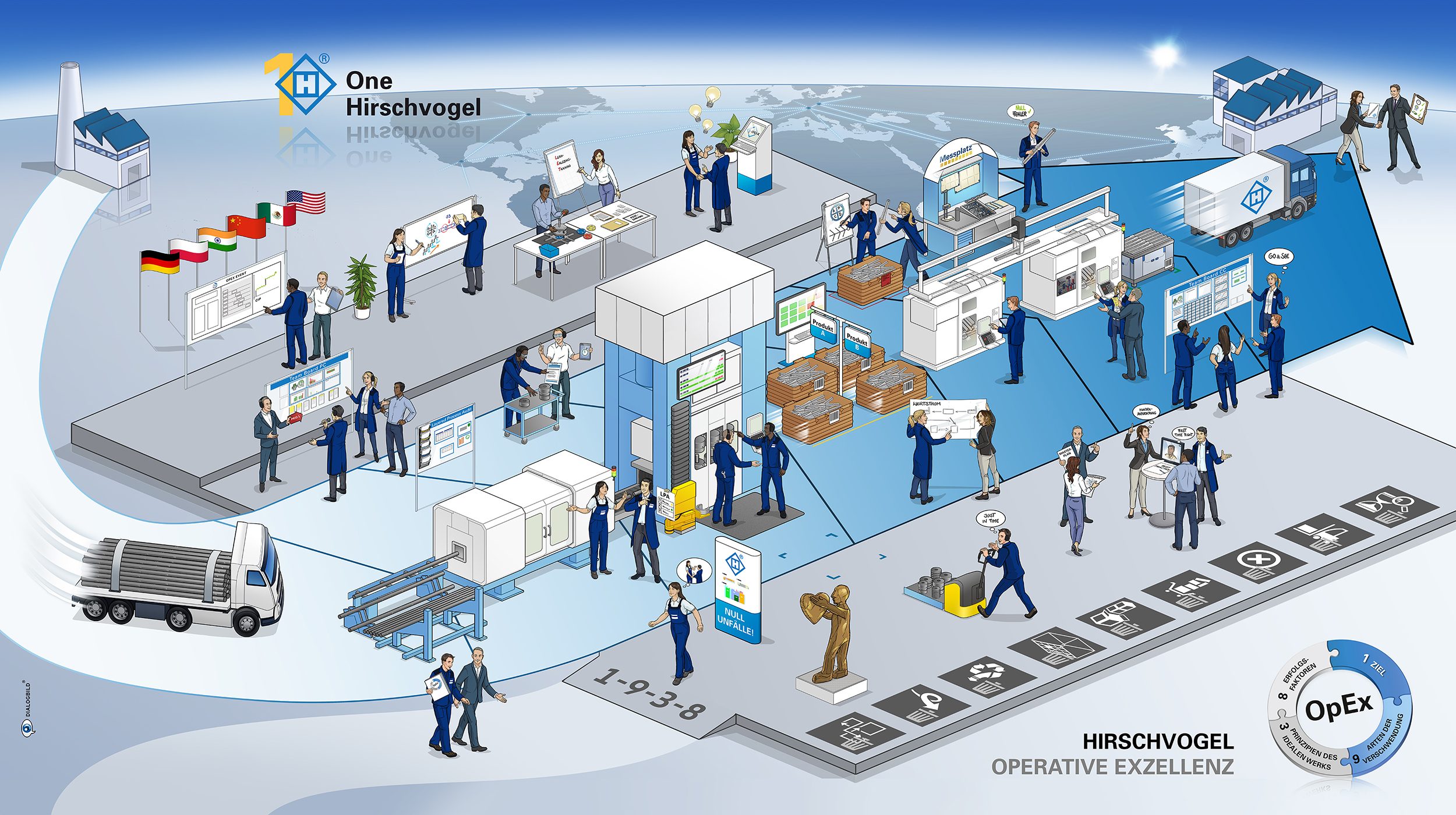
OPERATIONAL EXCELLENCE

The Hirschvogel Group is one of the world's largest manufacturers of forged and processed steel and aluminum components. The independent family-owned company with eight production companies on three continents is a development partner and manufacturing specialist, primarily for the automotive industry.

In order to achieve operational excellence, the company is prepared to constantly scrutinize its processes and continuously improve them in a targeted manner. Customer-oriented and value-adding processes are targeted across all areas - from production to administration.
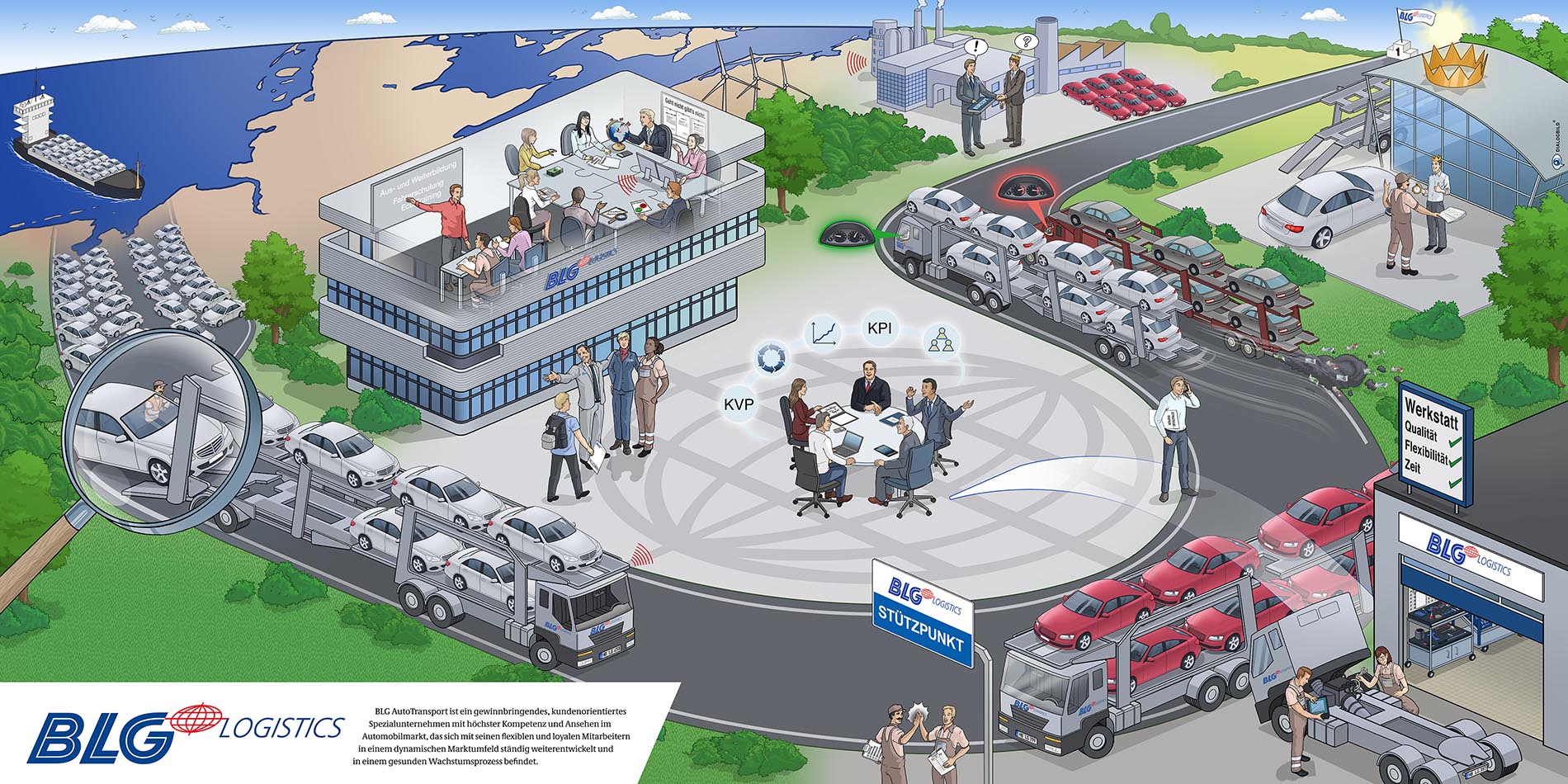

BLG Logistics Leitbild Strategiebild Dialogbild Agentur für Visualisierung von Prozessen, Veränderungen und Visionen.

Logo von BLG logistics

STRATEGY PICTURE


BLG AutoTransport is a globally-operating automotive logistics company. As a successful logistics provider it is significant to operate a common and consistent corporate strategy.

Regarding this challenge BLG AutoTransport approached DIALOGBILD. First of all, a joint work group of BLG AutoTransport and DIALOGBILD developed a visual framework and defined and created examplary scenes during several meetings. 
The main focus laid on a descriptive and sustainable communication of BLG AutoTransport′s corporate strategy. Their very own fleet of 400 trucks enables BLG AutoTransport to move more than one million vehicles each year.
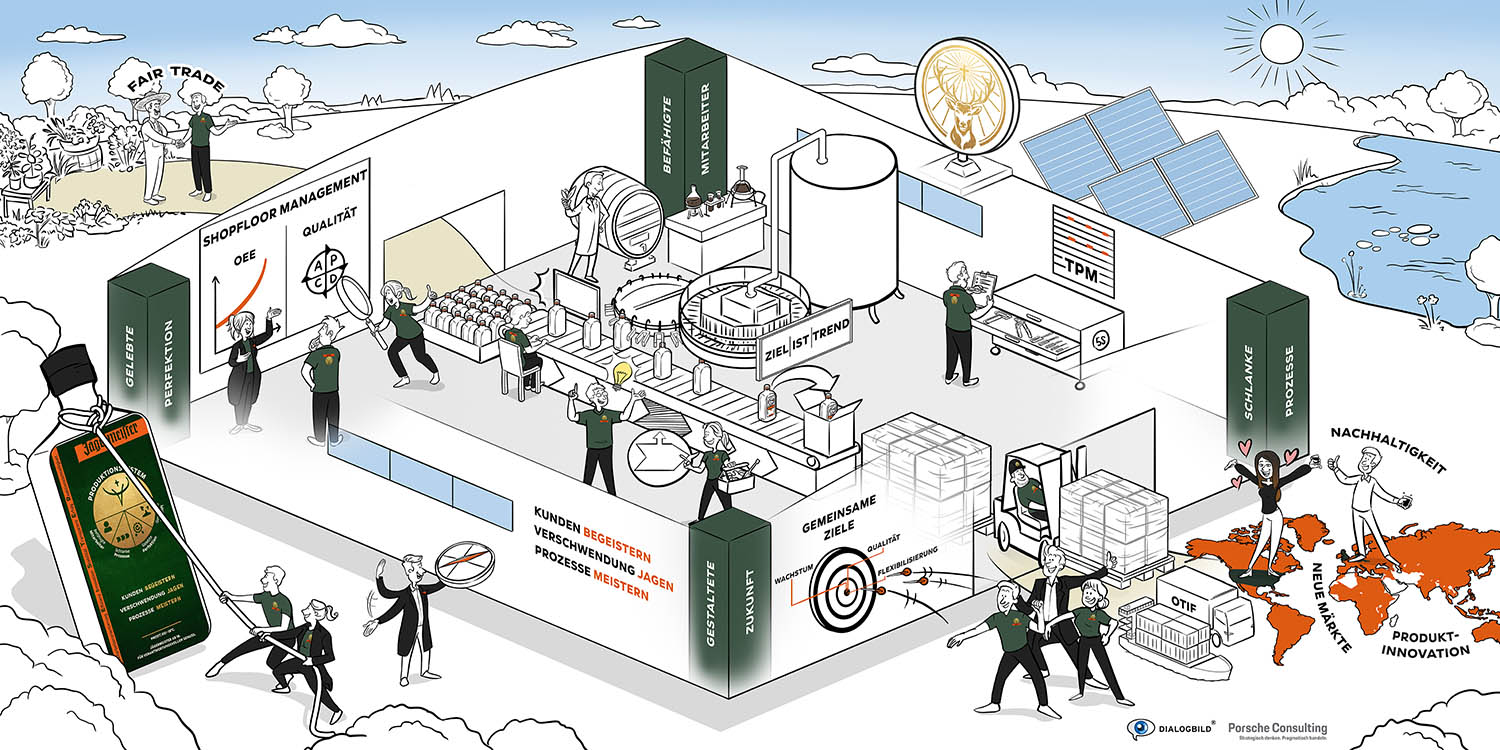

Jägermeister Produktionssystem Erklärbild Infografik Dialogbild Agentur für Visualisierung von Prozessen, Veränderungen und Visionen.

Jägermeister Produktionssystem Erklärbild Infografik Dialogbild Agentur für Visualisierung von Prozessen, Veränderungen und Visionen.

THE PRODUCTION SYSTEM


The Jägermeister production system
In 2017, the expansion and relocation of production lines in Wolfenbüttel Linden resulted in one of the largest and most modern spirits bottling plants in Europe. Driven by the vision of the new production system "Excite customers, hunt waste, master processes" the new Jägermeister production system (JMPS) was developed in cooperation with Porsche Consulting. The introduction is intended to drive goals such as efficiency and growth and to achieve greater flexibility in order to be able to respond to current trends.

The principles of the production system are represented by 4 massive cornerstones in the production hall: "Lived perfection. Shaping the future. Qualified staff. Lean processes." The End2End value stream, which is geared towards the customer, starts at the top left with the fair purchase of the ingredients and ends at the bottom right with the worldwide delivery of the products. The production with its new principles forms the centre of the dialog picture.
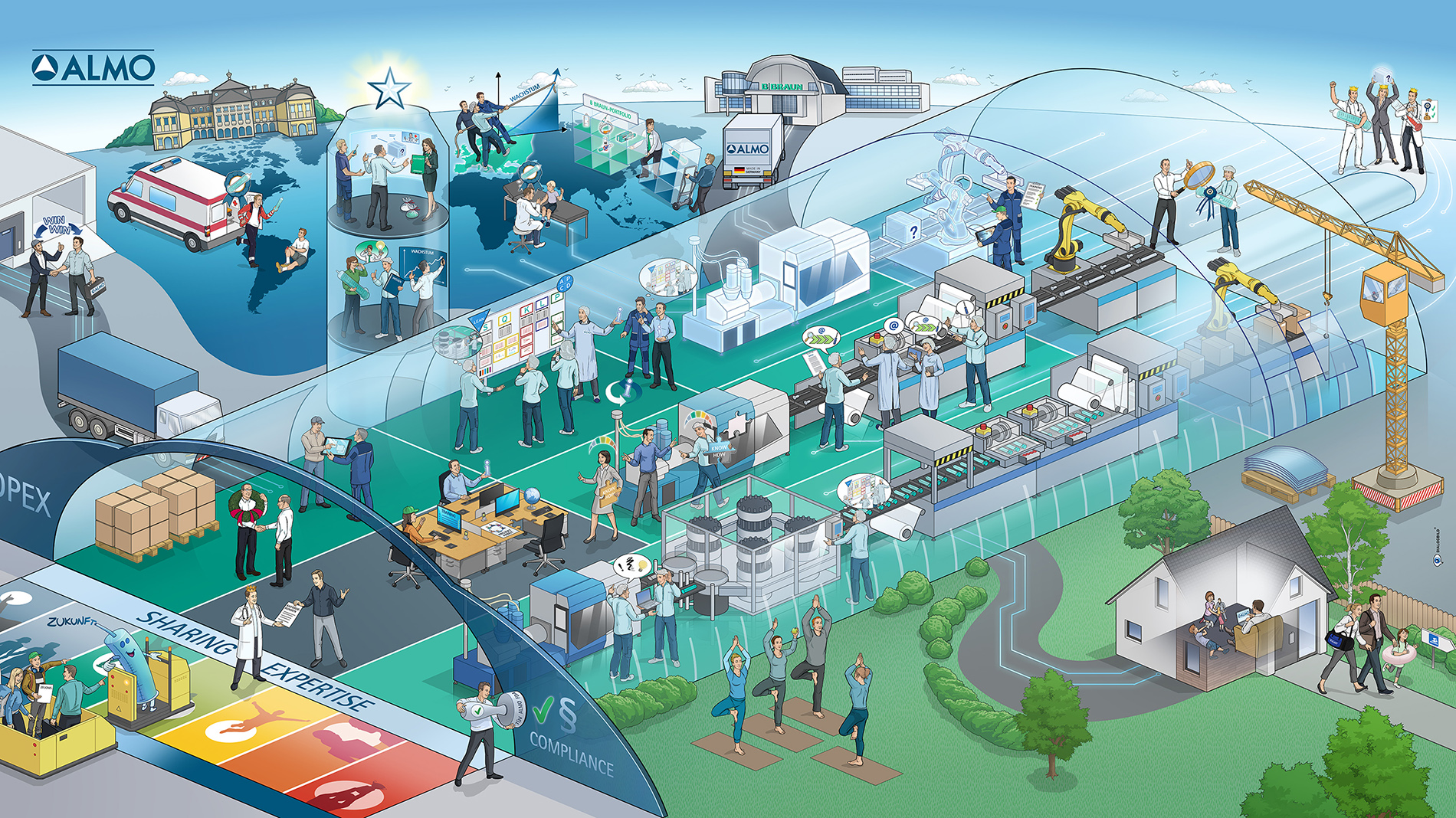
ALMO B.Braun Zielbild Leitbild Strategiebild Dialogbild Agentur für Visualisierung von Prozessen, Veränderungen und Visionen.

ALMO B.Braun Zielbild Leitbild Strategiebild Dialogbild Agentur für Visualisierung von Prozessen, Veränderungen und Visionen.

THE TARGET PICTURE


Creating transparency about the target system, making it understandable and easy to communicate to all employees, providing the opportunity for personal identification and describing the way into the future to ultimately provide a higher-level orientation for the entire company - these were the reasons why ALMO decided to create a dialog picture.
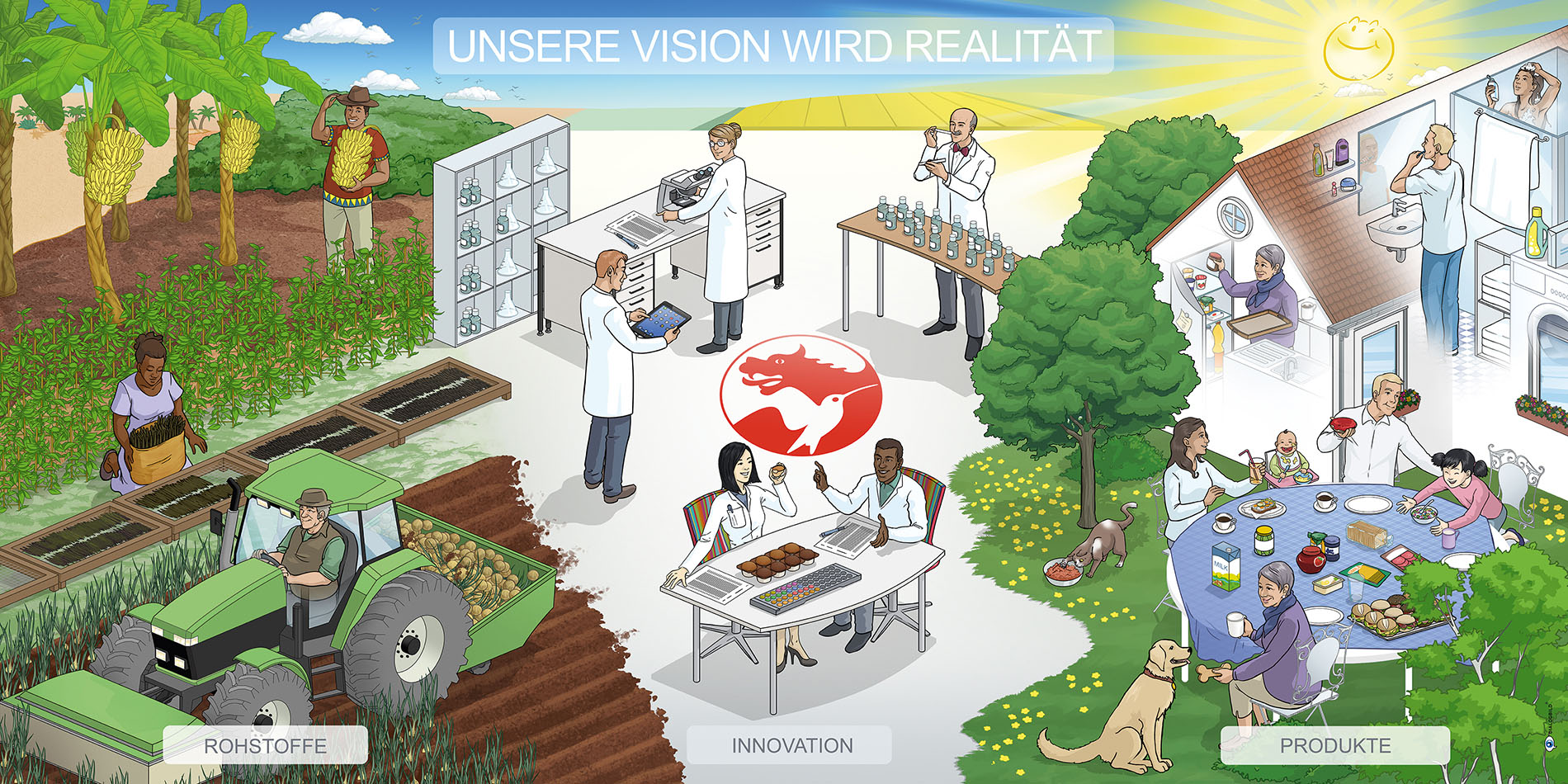

Symrise Visionsbild Leitbild Strategiebild Dialogbild Agentur für Visualisierung von Prozessen, Veränderungen und Visionen.

OUR VISION

Symrise AG is a global supplier of fragrances and flavors, basic and active ingredients, functional ingredients and product solutions for improved sensor technology and nutrition. With a share of approximately 12 percent, Symrise ranks third in the global market for fragrances and aromas and employs more than 10 thousand employees worldwide. Symrise is a reliable business partner and guarantees a high product quality. In the supply chain, quality consciousness, know-how and creativity perfectly interlock.

FAQ: Frequently asked questions about the value chain

What is a value chain?

The value chain describes all the activities a company undertakes to produce a product or service. Every activity, from sourcing raw materials to providing customer service, contributes to value creation. The goal is to create added value at each step that exceeds costs, thereby maximizing profit.

What is the difference between a value chain and a supply chain?

The supply chain focuses on the flow of goods, information, and finances from procurement to the end customer. The value chain is a broader concept that encompasses not only the physical flow but also all internal and external activities that create value for the company, including marketing, sales, and customer service. In short, the supply chain is a part of the value chain.

What role does value chain analysis play?

Value chain analysis is the process of examining the individual activities of the value chain to identify strengths, weaknesses, and areas for improvement. It helps you identify inefficient processes, reduce costs, and increase effectiveness. Targeted optimization is hardly possible without a thorough analysis.

How can I optimize my value chain?

To optimize your value chain, you can pursue various strategies:

  • Cost reduction: Identify unnecessary expenses and look for more efficient ways to do things.
  • Differentiation: Create unique added value for your customers that sets you apart from the competition.
  • Technology deployment: Use modern technologies such as automation, AI, or data analytics to accelerate and improve processes.
  • Visualization: Make your complex value creation processes understandable using visual tools such as a dialog picture to more easily identify bottlenecks and potential for improvement.

What trends are shaping value creation in industry?

Current trends that significantly influence value creation in industry include:

  • Digitalization and Industry 4.0: Networking and automation of production processes.
  • Sustainability: Integration of environmentally friendly and ethical practices throughout the entire supply chain.
  • Resilience: Building resilient supply chains that remain stable even in times of crisis.

These trends are crucial for successful value chain management in the modern economy.